Sunday, October 8, 2023

1970s Italian Horror Part Twenty-Seven

SO SWEET, SO DEAD
(1972)
Dir - Roberto Bianchi Montero
Overall: MEH

Leaning more on the police procedural side of the giallo spectrum, Roberto Bianchi Montero's So Sweet, So Dead, (Rivelazioni di un maniaco sessuale al capo della squadra mobile, The Slasher is the Sex Maniac, Penetration), is one of several Italian films that Farley Granger appeared in after moving to Rome for a number of years.  It also features Nieves Navarro, (Susan Scott), in a smaller part, doing what she usually does in such movies, namely getting naked and getting murdered.  The killer here is picking off promiscuous women who are all cheating on their prominent husbands, leaving photographs behind of their adultery to spice up the crime scene.  Granger is the frustrated police detective who is not only several steps behind the black hat/black trench-coat/black pantyhose-masked murderer, but also has to deal with the press taking regular pot-shots at his department.  Nothing unique to such movies and Montero's direction is largely lifeless, utilizing the usual slasher tricks of cutting out the soundtrack to readily announce the next kill scene.  Luigi Angelo's script is laughably infantile as well, featuring such things as a woman who witnesses the killer, the killer noticing he is being witnessed, and then said woman not even contemplating telling anyone in law enforcement as well as nonchalantly refusing her boyfriend's escort to her apartment later.
 
FOOTPRINTS ON THE MOON
(1975)
Dir - Luigi Bazzoni
Overall: MEH
 
The final full-length from filmmaker Luigi Bazzoni, Footprints on the Moon, (Le orme, Primal Impulse), adapts co-screenwriter Mario Fenelli's novel Las Huellas into a strange, psychological thriller of a disturbed woman dealing with traumatic bouts of amnesia and delusion.  Shot in both Turkey and Rome, cinematographer Vittorio Storaro captures the remote scenery of an off-season, island beach resort in a gorgeous manner, similar to Eduard van der Enden's photography on Harry Kümel's Daughters of Darkness from four years prior.  The isolated setting comes off as its own foreboding presence in this respect, as Florinda Bolkan seems perpetually frustrated there with her identity in question the entire time.  The plot line is vague and repetitive, yet this may be intentional as to mirror Bolkan's confused ordeal.  Both black and white as well as sepia-toned images of Klaus Kinski and suffocating astronauts regularly haunt her, so it can all mean some diabolical, experimental conspiracy or just the unhinged state of our protagonist.  The presentation is too aloof to fully captivate and the deliberate pacing gets the best of the movie, but it is a visual triumph at least that may wield more intellectually stimulating rewards upon further viewings.
 
DEATH STEPS IN THE DARK
(1977)
Dir - Maurizio Pradeaux
Overall: GOOD

By 1977, giallos were overdue for parody and though efforts in the past afforded plenty of silly plot points and exaggerated performances, Death Steps in the Dark, (Passi di morte perduti nel buio, Death Steps Lost in the Dark), leans into the comedy as much as it does black-gloved killers slicing victim's throats up.  The penultimate film and only the second giallo to be directed by Maurizio Pradeaux, it concerns Leonard Mann's reporter who gets mixed up with a murder on a train; a murder that gets uncovered by ridiculous ruses being played by the police as well as the surviving passengers who stage a "catch the killer" scheme that could only be conceived of by Italian screenwriters in the 1970s.  While the movie meanders during its second act by following around the less-than-gripping personal lives of secondary characters, the tonal balance of sleaze, bright-red-bloodshed, and intentionally silly pitter-patter between everyone on screen is sufficiently handled by Pradeaux.  Vera Kruska is delightful as Mann's Swedish, airhead model girlfriend, as is Robert Webber who prefers complaining about having indigestion during a crime scene investigation and arresting a casual coke dealer instead of the person who he has a warrant out for when given the chance.  Low on suspense maybe, but it is also light on its feet with tongue-in-cheek performances, some brutal slayings, and a refreshingly humorous take on well-worn tropes.

Saturday, October 7, 2023

1970s Italian Horror Part Twenty-Six

SLAUGHTER HOTEL
(1971)
Dir - Fernando Di Leo
Overall: MEH
 
A lackluster and sleazy giallo with an underused performance from Klaus Kinski, Slaughter Hotel, (La bestia uccide a sangue freddo, Asylum Erotica, Cold Blooded Beast, Les insatisfaites poupées érotiques du docteur Hitchcock), has an occasionally wild soundtrack yet little else going for it.  The first film of the 1970s to be directed by Fernando Di Leo, the location was previously used in the 1966 film The Murder Clinic and its gets an exclusive work out here as the entire movie unfolds there, with a clandestine killer haphazardly murdering women in such a leisurely structured sanatorium.  Practically every woman on screen takes her clothes off at some point, especially Lady Frankenstein herself Rosalba Neri who portrays a nymphomaniac what will writhe around on her bed or frantically run back in forth in the shower if not in the warm embraces of a man.  Everyone else on screen is otherwise interchangeable though and equally horny, so the audience is naturally uninvested in who gets picked off and for what reason.  The killer reveal is as nonsensical and unimportant as any from such movies and the plotting is horrendously repetitive, but the avant-garde music and sound design prove memorable, plus Franco Villa's cinematography is more atmospheric than the brain-dead material deserves.
 
CRIMES OF THE BLACK CAT
(1972)
Dir - Sergio Pastore
Overall: GOOD
 
A rare stab, (pun intended), at giallo from director Sergio Pastore, Crimes of the Black Cat, (Sette scialli di seta gialla, Seven Shawls of Yellow Silk), is an above average one with some much appreciated pizazz from behind the lens.  Genre mainstays Anthony Steffen and Giacomo Rossi Stuart are both present with the former playing a blind man who keeps annoying the police with his of course completely correct assumptions about the killer that he believes to have overheard and/or smelled at the beginning of the film.  Such a gimmick is well utilized, particularly in the final set piece where Steffen thwarts his pursuer, a scene that ends in one of the most hilarious, "nothing more to see here" freeze-frames in giallo history.  There is no repetitive musical score to keep one annoyed and it is also refreshing that Pastore and cinematographer Guglielmo Mancori keep the camera work on the flashy end, also structuring atmospheric, eye-popping shots on occasion.  It is not as stylized as Dario Argento's more wacky work for obvious comparison, but it has just enough convoluted plot details to keep the pace snappy instead of overbearing, plus the kills feature somebody throwing a cat at people so that is certainly something.
 
THE PYJAMA GIRL CASE
(1977)
Dir - Flavio Mogherini
Overall: MEH

Based on a 1934 Australian cold case of a woman whose severely burned body was found inside of an abandoned car on a beach, (a woman who was wearing distinctly designed pajamas), the apply titled The Pyjama Girl Case, (La ragazza dal pigiama giallo, The Girl in Yellow Pyjamas), is a fragmented, kind-of giallo from co-writer/director Flavio Magherini that focuses on two parallel narratives.  On the one hand, it is an interesting idea to split various factual elements from the real, true crime inspiration into two different stories, but it makes for a confused watch that takes some getting used to.  Due to the double narrative, the one-hundred and three minute running time feels bloated as neither story links up, making this almost like an anthology movie if both segments were bounced between throughout.  An elderly looking Ray Milland is fun as a retired detective who is pleased to be back on a case in order to have something to do, but Dalila Di Lazzaro has a more difficult time in the equally convoluted and underwritten other story as a troubled young woman with three different lovers.  The music is typically repetitive, including two songs by Amanda Lear; the slow disco "Look at Her Dancing" and the romantic theme "Your Yellow Pyjama".

Friday, October 6, 2023

1970s Italian Horror Part Twenty-Five

TRAGIC CEREMONY
(1972)
Dir - Riccardo Freda
Overall: MEH

Tragic Ceremony, (Estratto dagli archivi segreti della polizia di una capitale europea, Extracted from the Secret Police Archives of a European Capita, Trágica ceremonia en villa Alexander), was the penultimate film of Riccardo Freda's directing career and it blows a conventional premise with a bombardment of confused obstacles.  It has the bog-standard set-up of several young, attractive people who are on some kind of vacation/joyride/retreat, only to get stranded somewhere unwholesome for the night, but Freda and screenwriter Mario Bianchi cannot keep their story remotely straight, let alone compelling.  The perpetually naked Camille Keaton stares off into space for most of her scenes and several moments happen where gruesomely murdered bodies are discovered by the people who then take a nap or just lackadaisically relax in the sunny grass soon afterwards.  The macabre, bloody showpiece of the film, (taking place during a Satanic ritual being interrupted), is bizarrely staged and and more laughably perplexing than interesting.  Visual window dressing such as a Gothic castle, gore, and ghastly make-up are nice, yet on top of the aforementioned issues, the plot is meandering, the pacing is typically cumbersome, and the acting is flat.
 
NIGHT TRAIN MURDERS
(1975)
Dir - Aldo Lado
Overall: MEH
 
While Aldo Lado's take on Ingmar Bergman's The Virgin Spring fares infinitely better than Wes Craven's insultingly abysmal piece of shit The Last House on the Left, Night Train Murders, (L'ultimo treno della notte, Last Stop on the Night Train, Late Night Trains, The New House on the Left, Second House on the Left, Don't Ride on Late Night Trains), still proves to be unnecessary if adequately done exploitation.  On the plus side, Lado shies away from graphically showing the story's most grisly aspects, giving the audience just enough on-screen information to loathe the movie's villains and to fully comprehend the disturbing nature of the material.  In place of overt ickiness and violence though, the pacing suffers as nothing of any considerable concern happens until past the halfway point.  This allows for us to get to know the two innocent victims who are just returning home to visit their parents on Christmas, but is also bores us with "Lemme tell ya what the problem is with the youth of today" squabblings from minor characters, a nearly five minute opening title sequence set to awful music, and a first act of nothing more than people being late for a train, trying to find a place to sit on a train, and then being asked if they have tickets to ride the train.

PENSIONE PAURA
(1978)
Dir - Francesco Barilli
Overall: MEH

Francesco Barilli's return to giallo after a four year directorial break was the moody yet narratively void Pensione paura, (Hotel Fear).  Barilli admittingly took on the project for financial reasons, clashing with one of the film's four credited producers Tommaso Dazzi during shooting.  The results are messy in this respect as the plot detours at regular intervals even if it stays atmospherically on track.  Taking place in a dilapidated hotel where dubious guest wait out the war by sexually harassing the establishment's lone employee whose mother has recently died, it has a dour tone that is enhanced by excellently haunting music from Adolfo Waitzman and occasionally stylish cinematography from Gualtiero Manozzi.  Unfortunately, Barilli's pacing is problematically listless and the story meanders endlessly with Leonora Fani's sheepish protagonist going about her daily business and getting regularly interrupted by pushy perverts who gradually get picked off by a mystery person in a trench coat.  The ending is both unsatisfying and random, but it does allow for Fani's traumatized character to settle into a life of delusional melancholy that is in keeping with the movie's melancholic agenda.

Thursday, October 5, 2023

1970s Italian Horror Part Twenty-Four

THE IGUANA WITH THE TONGUE OF FIRE
(1971)
Dir - Riccardo Freda
Overall: MEH

Giallos were already a dime a dozen by the time that Riccardo Freda took a swing at one with The Iguana with the Tongue of Fire, (L'iguana dalla lingua di fuoco).  As the genre always insists, the dark-gloved killer is kept secret until the final confrontational showdown between them and the main, good guy protagonist, (Luigi Pistilli's police detective in this case), and numerous tricks are played on the audience to throw them off.  The blood is also tomato soup red and the kills are gruesome, which are both fine and swell elements to such movies.  As typically convoluted as the story is, the final reveal is probably one of the least exciting in any giallo, yet what really disappoints is how dull it all plays out.  The grisly murders are spread out too far and most of the victims are people who are barely important to the plot.  This is actually a case where Freda could have afforded to go a little more overboard for entertainment's sake, something that Dario Argento for one excels almost to a fault at, if we are to compare.  Freda and cinematographer Silvano Ippoliti do pull off some flashy camerawork here or there, but the director himself dismissed the final product to the point of removing his actual name from the credits, instead going with his own Alan Smithee pseudonym Willy Pareto.
 
AMUCK!
(1972)
Dir - Silvio Amadio
Overall: MEH

His second of two giallos cranked out in 1972, Amuck!, (Alla ricerca del piacere, In Pursuit of Pleasure, Maniac Mansion, Hot Bed of Sex, Letter and Whips), finds writer/director Silvio Amadio working with Farley Granger as well as Euro-queens Rosalba Neri and Barbara Bouchet.  More sexually-tinged than stylistically garish or cartoonishly plotted, (though it still busts out the convoluted details in its final moments), it bypasses the black-gloved killer/endless red herrings cliche, instead answering the central mystery at the onset of the third act.  That said, there is still a rug-pull in the last few minutes, be it a foreseeable one that finds the shady, degenerate behavior of Granger and Neri's hedonistic couple to be as steadfast as it was promised.  A slow motion, lesbian sex scene and characters who are privy to manipulate, harass, and fall in love with each other make this an erotic offering in lieu of copious amounts of bright-red blood-shed.  Still, the sluggish pacing and anti-climactic nature of the material is likely to leave most viewers checking out of the proceedings at regular intervals.  Well shot, melodramatically performed, and refreshingly against the giallo type in several respects, it also whimpers instead of dazzles along its route.

LA BESTIA IN CALORE
(1977)
Dir - Luigi Batzella
Overall: WOOF

Italian filmmaker Luigi Batzella's entry into the laughably stupid Naziploitation genre was the fittingly lousy La Bestia in calore, (The Beast in Heat).  Mixing recycled war footage from Batzella's earlier movie Quando suona la campana with unwholesome, (Is there any other kind?), torture and rape scenes, it manages to be as redundantly boring as it is sleazy.  Pornographic in nature with full genitalia and the mutilation of such genitalia being a main ingredient, the presentation is so obnoxious in its shock-value that it just becomes an embarrassing experience for all involved.  Macha Magall seems to be going through the motions as the naked, despicable Nazi mad scientist/henchwoman, having none of the icky charisma of Dyanne Thorne in the also repugnant Ilsa, She Wolf of the SS series.  Poor Salvatore Baccaro gets it worst of all though as the full-frontal, title mutant rapist who raves and grunts with exaggerated duck lips in his animal cage.  When all of the nasty X-rated mayhem is not front and center, the plot line takes over and it is inconsequential enough to completely ignore.  Something about both sides of the war trying to sabotage one side while getting information from the other, plus everyone on screen is either forgettably one-note or just an unrepentant asshole anyway.  In other words, the movie is ugly trash from front to back.

Wednesday, October 4, 2023

1970s Italian Horror Part Twenty-Three - (Luciano Ercoli Edition)

FORBIDDEN PHOTOS OF A LADY ABOVE SUSPICION
(1970)
Overall: MEH
 
Director Luciano Ercoli's first giallo collaboration with screenwriter Ernesto Gastaldi, (though in typical Italian cinema fashion, other hands were credited with the script as well), Forbidden Photos of a Lady Above Suspicion, (Le foto proibite di una signora per bene), leans into the sexual perversion of such films, even if the actual nudity is kept to a minimum.  In fact it plays the usual, sensationalized cliche of characters gaslighting a central, female protagonist into thinking that all of the foul play that she is enduring is merely a byproduct of her sexually repressed imagination.  The audience of course knows better as the psychological gag is clearly a ruse and of course there is a melodramatic rug pull in the final moments as far as who is behind such shenanigans; a rug pull that is either genuinely surprising or laughably predictable depending on how accustomed the viewer is in deciphering giallo red herrings.  Formulaic plot devices aside, Ercoli and cinematographer Alejandro Ulloa give the movie a classy, stylish sheen, (plus Ennio Morricone's musical score is a toe-tapper), but the pacing slags and the whole thing fails to play up its inherently sleazier aspects in a better-suited, grandiose manner.
 
DEATH WALKS ON HIGH HEELS
(1971)
Overall: MEH
 
For his second giallo in a row Death Walks on High Heels, (La morte cammina con i tacchi alti, Death Stalks in High Heels, Nights of Love and Terror), director Luciano Ercoli brings back Simón Andreu and his wife/spaghetti Western scream queen Nieves Navarro; both actors of whom get to roll in ze hay together.  The red herrings are piled on high in this one as the structure gradually abandons any type of sensationalized style and settles into a convoluted diamond theft/police procedural/murder mystery.  At over a hundred minutes in length, the movie tries the viewer's patience with its drawn-out plot line that comes up with futile explanations to sell us on who the culprit is; a reveal that of course does not fully arrive until the very last moments.  Stelvio Cipriani's jazz musical score is zippy and creates the kind of swinging Italian mood that is typical with such movies, jiving oddly with all of the bright red blood and killings that transpire.  Ercoli plays everything straight in what is an overtly talky affair, with the aforementioned kill scenes being few and far between.  The more sexually-charged elements are also abandoned by the time that the second act hits, so anyone hoping to watch Navarro perform endless naked stripteases in outlandish wigs or borderline blackface makeup will have to settle for such things getting out of the way early on.

DEATH WALKS AT MIDNIGHT
(1972)
Overall: MEH

As convoluted as any giallo out there, Death Walks at Midnight, (La morte accarezza a mezzanotte, Muerte acaricia a medianoche, Cry Out in Terror), is the third in a row from director Luciano Ercoli and screenwriter Ernesto Gastaldi to feature both the former's wife Nieves Navarro and actor Simón Andreu.  Everyone keeps their clothes on for this one and there is no perverse angle to be found, the story instead focusing on the endlessly condescending attitude that every man has towards Navarro's frustrated protagonist and the many, many dubious people and things that she keeps witnessing yet is never able to substantially prove.  It is bad enough when her love interests perpetually gaslight her, but when the police force dismiss her persistent concerns and oodles of shady coincidences to corroborate her story, the movie begins to indulge too much in one of the genre's sillier and more aggravating cliches.  We certainly feel Navarro's irritation with the whole tangled scenario and even though the film feels its one-hundred and three minute length with its repetitive plot, the performances are melodramatic enough to amuse.  The spiked-gauntlet violence is a wasted gag though, only being teased in an unexplainable, drug-infused hallucination in the first scene and once or twice after that, particularly when the killer inexplicably reveals his entire master plan before dispatching of his would-be final victim.  It is ridiculous business to be sure, but is also has a dragged-out, knock-down finale as well as plenty of J&B references for giallo fans to appreciate.

Tuesday, October 3, 2023

1970s Umberto Lenzi Part Two

SEVEN BLOOD-STAINED ORCHIDS
(1972)
Overall: MEH

The giallo formula is strategically adhered to in Umberto Lenzi's Seven Blood-Stained Orchids, (Sette orchidee macchiate di rosso); a sufficient entry into the genre that plays it by-the-books.  As opposed to being wildly stylistic or overtly sleazy, (though a few of the female victims are without clothes on and a heroine addict is featured), the movie is more akin to German krimi films and not just in the fact that it is a West German co-production with lead actor Uschi Glas also hailing from there.  A police procedural mystery first and foremost, it keeps the more ridiculous giallo trademarks at bay while still liberally featuring the other textbook ones.  A minimal number of musical pieces are used ad nauseum, the murderer is not revealed until the last five minutes, said killer wears black gloves and leaves a calling card behind, the plot line exclusively deals with the both the police and one guy who is personally involved following up leads, the kills are largely against women, Lenzi's abuse of camera zooms is excessive, etc.  Though there is a sufficient amount of information divulged in Lenzi and Roberto Gianviti's script, it follows a linear path that is easy enough to grasp without getting too unnecessarily bloated.
 
SPASMO
(1974)
Overall: MEH
 
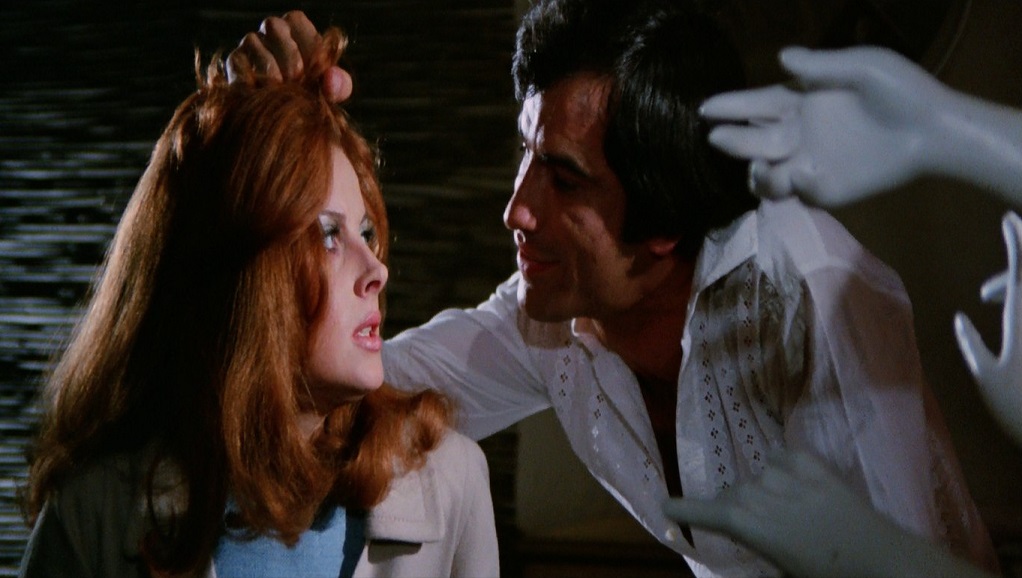
Falling into the giallo genre even though many of its narrative components are left of center, Umberto Lenzi's Spasmo is still a convoluted mess.  The film was allegedly going to be a product for Lucio Fulci who was replaced by producers with Lenzi coming in and heavily rewriting the script that ultimate had half a dozen names attached to it.  This is hardly surprising when viewing the result, which has various, forced attributes along with typical aspects of Italian thrillers such as unintentionally funny dialog, rape, the same piece of music played throughout most scenes, and a character with a disturbed childhood that influences bouts of psychotic madness.  While it is refreshing to replace the usual black gloved killer and red herrings, what is left is something that is often meandering and difficult to follow.  The mystery is of a different variety as to who seems to be fucking with Robert Hoffmann's troubled protagonist, but the answer to that question comes only about an hour in which leads to a whimpering finale that is both lackluster and silly.  Speaking of silly, one of Lenzi's daft contributions was the addition of several mannequins in lingerie who are randomly given screen time at irregular intervals; something which does get a pay off in the aforementioned finale that is likely to cause either eye-rolls or bouts of laughter.
 
EYEBALL
(1975)
Overall: MEH
 
A completely uninspired giallo from filmmaker Umberto Lenzi who already had a number of such movies under his belt at this point, Eyeball, (Gatti rossi in un labirinto di vetro, Red Cats in a Glass Maze), is endlessly chatty, has an incompetent-at-best killer, and is lacking in the overt strangeness, style, and sleaze that is commonly found with the more outrageous entries in the sub-genre.  This is surprising coming from a film whose gimmick is a murderer that removes their victim's eyes, but this quirky gimmick is rarely touched upon and only becomes outlandish within the last five minutes.  Before that, it is a monotonous bore as a soon-to-be-retired police inspector keeps a group of tourists held up for questioning after questioning, all while a couple more people get picked off in an unexciting manner where just as many of the killer's attempts end up embarrassingly futile.  Some of the cast members are recognizable, but none of them are allowed to bring their melodramatic A-game with such lackluster material that is handled in a merely competent manner by Lenzi from behind the lens.  Distinguishing factors are limited enough to make this almost entirely forgettable, even by giallo's often textbook standards.

Monday, October 2, 2023

1970s Umberto Lenzi Part One

A QUIET PLACE TO KILL
(1970)
Overall: MEH
 
Director Umberto Lenzi and star Carroll Baker's first collaboration of the 1970s immediately follows their previous two and is melodramatic fluff for the most part, despite one or two suspenseful moments.  A Quiet Place to Kill, (Paranoia, Una droga llamada Hele), finds Baker playing a race car driver who goes to hang out with her dashing, womanizing ex husband Jean Sorel, (who she previously tried to kill), at he and his new wife's luxurious estate.  What follows is a hilarious string of manipulation via murder where almost every character on screen is revealed to be duping the other in a cockamamie murder scheme.  Why so many people play nice while secretly teaming up with someone else in order to get yet another person out of the way is poorly explained from a logical perspective, which is nothing new to such Italian-style, sensationalized silliness.  It does not make for the most compelling watch though as Lenzi and cinematographer Guglie Imo Mancori have nothing to offer stylistically besides a copious amount of camera zooms as well as the usual jazzy musical accompaniment.  One moment where everyone reviews some film footage of what could expose the murderers is done in an intentionally gripping manner, plus Baker gets to drive around like a maniac on winding mountain roads after already suffering from a serious racing insistent, all of which cues the audience in no subtle way to the fact that her character is a wild one who is not to be trusted.
 
OASIS OF FEAR
(1971)
Overall: MEH

When a movie's director allegedly states that "If I could burn that film, I'd do it!", then the viewer can logically assume that said filmmaker is not talking about a well-crafted pieces of celluloid.  While Umberto Lenzi's Oasis of Fear, (Un posto ideale per uccidere, An Ideal Place to Kill), is not as bad as all that, it is also not one of the more memorable Italian hippy thrillers that the early 1970s produced.  Lenzi apparently came up with the concept on the fly as to fulfill a contract obligation to producer Carlo Ponti, only to settle on actors that he felt uncomfortable working with.  In any event, the story finds two young, hedonistic trouble-makers on the run from the law after getting busted for selling pornographic pictures of themselves, eventually ending up at a wealthy, middle-aged woman's home who has recently murdered her husband and decides to pin it on her attractive, horny guests.  That scheme actually goes better than one would expect from such movies that were routinely full of double-cross after double-cross, but it all plays out in too simplistic and droll of a manner.  Lead actor Ray Lovelock's upbeat rock song "How Can You Live Your Life?" shows up in various incarnations and is as overused and annoying as any from Italian genre cinema of the day, but besides some naked people and mild debauchery, said piece of music is also the only close-to memorable thing going on here.
 
KNIFE OF ICE
(1972)
Overall: MEH

The fourth and final collaboration between director Umberto Lenzi and actor Carroll Baker was Knife for Ice, (Il coltello di ghiaccio, Vertigine, Detrás del Silencio, The Ice Pick); a giallo that takes its title from an Edgar Allan Poe quote and was inspired premise-wise by the 1946 film The Spiral Staircase.  Baker plays a young woman who was rendered mute after witnessing the traumatic death of her parents, with a series of murders taking place at her villa that point to everything from an assumed sex maniac, to a suspicious hippy with glassy contact lenses for eyes, to a Satanic cult.  The ultimate reveal is one of several for film's in the sub-genre that ends up being accidentally predictable due to it also being the last culprit that the audience suspects; an audience who was already well-trained enough by 1972 to guess the least likely person involved.  Void of both nudity and violence, with the infrequent kills scenes mostly happening off-screen, it is not the most exploitative giallo there is.  The gimmick of having its top-billed, American star have no dialog carries the film to a point, but its red herrings are far more interesting than what is actually proven to be happening, plus the tame presentation could use some more outlandish style to kick it into a higher gear.