Monday, January 19, 2026
2025 Horror Part Six
Monday, August 5, 2024
1950s Foreign Horror Part Three
Dir - Karel Zeman
Overall: MEH
A notable fusing of 2D and 3D model animation with live action, Journey to the Beginning of Time, (Cesta do pravěku), serves its purpose as a lightweight educational film for its era. Director Karel Zemun had and would continue to make a number of movies that relied heavily on special effects and animation, and this one takes its narrative cue from two novels, Vladimir Obruchev's Plutonia from 1915 and Sir Arthur Conan Doyle's The Lost World from 1912. Throwing four jolly-wiz teenagers into a raft where they inexplicably end up in and innocently explore Earth's bygone, pre-human eras is dopey stuff, but it works fine in the context of a documentary where the kids constantly notify the audience as to the specifics of their findings. The American re-edited throws in bookending segments at the American Museum of Natural History in New York that "explain" the movie's events as an elaborate dream, but the bulk of the film was shot at a Czech nature reserve, two different rivers, and conventional studio sets. The prehistoric beast shots are noticeably smoother than Ray Harryhausen's stop-motion and blend with the young actors as well as any from the time period, but there are also puppets utilized as well as a convincing, life-sized model of a defunct Stegosaurus.
Saturday, December 23, 2023
1980s Foreign Horror Part Twenty-Four
Wednesday, May 10, 2023
1930s Foreign Horror Part Four
Monday, April 10, 2023
2016 Horror Part Twelve
Wednesday, December 30, 2020
2000s Foreign Horror Shorts
Dir - Peter Cornwell
Overall: GOOD
Saturday, August 22, 2020
1980s Animated Czech Horror
(1980)
Dir - Viktor Kubal
Overall: MEH
The last of three films directed by animator/cartoonist Viktor Kubal, Krvavá pani, (Bloody Lady), is a more fairytale-esque retelling of the legend of Lady of Čachtice/Erzsébet Báthory as opposed to a particularly horrific one. Besides some brief narration at the very beginning to set the scene, there is no dialog present and this makes some of the details going on a bit difficult to decipher. At only seventy-one minutes, it is more of a problem how painstakingly slow the film is though. There is very little bloodshed and no standard, vampiric components usually common with other cinematic interpretations of the same source material. While that is all fine, the elemental animation frequently pauses and with nothing besides sound effects and clashing music to help further guide the story, it struggles regularly to be engaging. The deliberately simple, largely unemotional style does benefit the material at times, but it still mostly makes it rather impenetrable.
THE PIED PIPER
(1986)
Dir - Jiří Barta
Overall: GOOD
A largely superb work of stop-motion animation, Jiří Barta's The Pied Piper, (Krysař), is a heavily German Expressionist-inspired adaptation of the Pied Piper of Hamelin folktale. Produced by Kratky Films, it took six months to research and a year to shoot. The handmade puppets by Barta are intricately designed to appear almost monstrous, mirroring their gluttonous, unflattering nature. It is no mistake then that the two characters who appear to have normal, more elegant features are a woman who ultimately suffers at the hands of the townsfolk and a small infant left behind which signifies their innocence. The music by Michael Kocáb plays a major role as the "dialog" is an intentional jumble of indistinguishable sounds spoken only by the grotesque inhabitants to further paint them as unnaturally villainous. It is mostly the visual design that steals the show though. Utilizing real life rats and some lovely two-dimensional paintings with the highly stylized stop-motion animation, the film plays off this juxtaposition while presenting a foreign world that is as fantastical as it is dark.
ALICE
(1988)
Dir - Jan Švankmajer
Overall: GOOD
Possibly the most inventive of any Alice in Wonderland adaptation was by animator Jan Švankmajer, simply titled Alice, (or Něco z Alenky in its native Czech). Having made a hefty amount of shorts beforehand, Švankmajer chose the Lewis Carroll novel to interpret as his full-length debut. The surreal landscape of the famous source material makes for an ideal backdrop for strange stop-motion creations to rather ingeniously come to life. These are not limited to a gang of skeleton animals with sawdust for guts, possessed dollhouses, thick, fleshy frog tongues, and a comically repetitive tea party including a wooden puppet Mad Hatter getting buttered stopwatches attached to him. The film is structured not at all like a fairytale, but instead as an avant-garde series of vignettes, none of which follow any particular logic or narrative. It is further stylistically bizarre that there is no musical score and that all of the dialog, (no matter who authored it), is spoken by Alice who is systematically experiencing the story and reading it all at once. While Kristýna Kohoutová is the only human actor on screen, puppets, meat, clay, drawings, and live animals all intermingle and Švankmajer's design work overall gives it an earthy, oddly-lived in look that is frequently unnerving.
Saturday, July 4, 2020
1970s Foreign Horror Part Ten
(1970)
Dir - David Cronenberg
Overall: MEH
This sophomore effort from David Cronenberg follows a similar structure as Stereo, his debut from the year before. Featuring no dialog yet instead a commentary by actor Ronald Mlodzik, (who also started in Stereo), and running for just over an hour in length, Crimes of the Future is certainly not a horror film, but it is also not particularly good either. Focusing on a post-plague, dystopian future, you would not necessarily pick up on this as it is mostly just a weirdo going into medical clinics and doing things like looking at organs in jars, licking people's feet, smiling at them as they take women's underwear out of bags, and pretending to be crippled while someone else tries to bend his knees. He is apparently musing about or looking for his mentor, talking very slowly about it the whole time. This all might mean something or it might instead just be a lot of pretentious, art movie nonsense. While the pacing is insufferable, Cronenberg, (who also shot and edited the film), is juggling some ambitious ideas and it is occasionally engaging from a visual standpoint. It is a shame that the film is rather dull and half-baked, but it is still a mildly interesting, disturbed watch for fans of one of the genre's most renowned filmmakers.
FANTASTIC PLANET
(1973)
Dir - René Laloux
Overall: GOOD
This Czech/French co-produced science fiction animated film from René Laloux was his first of three full-length ones and remains the most famous. Co-scripted by Laloux and illustrator Ronald Topor, themes of animal and human rights as well as racism are explored via a highly advanced, gigantic, meditating blue race of beings called Draags who keep primitive humans, (called Oms), as pets. While it all unfolds perhaps too gradually in some places, the bizarre, hugely stylized visual design of Fantastic Planet, (La Planète sauvage, Divoká planeta), keeps it endlessly fascinating. Each race that the story has put at odds with each other are equally sympathetic to the viewer and all the way through, the movie connects its allegorical ideas in a rather unambiguous way. At the same time, the hip, wah-wah guitar heavy soundtrack from jazz musician Alain Goraguer and computerized sound effects augment the extraordinary and singular animation. It makes for a highly imaginative whole; dark in some places, slow in others, positively weird in most, and anything but forgettable.
LAND OF THE MINOTAUR
(1976)
Dir - Kostas Karagiannis
Overall: WOOF
For reasons that may never be properly explained, Peter Cushing and Donald Pleasence both started in a rare Greek horror film with none other than Brian Eno providing the score. That is not necessarily the weird part. The weird part is that Land of the Minotaur, (The Devil's Men), is an embarrassing, insultingly boring mess that no one would probably remember if not for the aforementioned personnel inexplicably being involved. Cushing could not make a mockery out of any of his performances if he tried, but thankfully the production did not work him too hard, instead leaving more scenes for Pleasance to yell at a guy driving a car to hurry up and go faster. As far as Eno is concerned, the music is barely noticeable and it is not like he got a trip to Greece in the summer time like the cast did so again, his reasons for participating are questionable. As far as everything else, there is a cult that worships a statue, a priest trying to stop them, women disappearing, and other stuff that you will immediately forget about after it happens. No mystery, no suspense, nonsensical everything. The sacrificial altar looks OK though. Still, it is probably best to just move on and assume that this was never made.
Friday, June 19, 2020
1970s Czech Horror Part Two
(1971)
Dir - Anna Procházková
Overall: MEH
This television drama serves as the only cinematic Dracula adaptation made in the Czech Republic. Shot in black and white with soap opera lighting, Hrabe Drakula, (Count Dracula), is certainly a low budget affair, but not in a adverse way. While the film jumps set pieces rather abruptly at times, it still condenses Bram Stoker's novel rather impressively since it does only run seveny-six minutes. Naturally, it is rather void of gore and emphasizes virtually no sex appeal, but that is solely a fault of the television medium from the era as opposed to any byproduct of the filmmakers. On that note, some of the effects are well-executed despite the meager production values. The vampires speak telepathically and appear transparent at times and all of the scenes at Dracula's castle fare better than the more stagey, interior set ones. It is not without some other issues though. The ending is underwhelming and suffers the most from the minimal length, Ilja Racek does not get enough screen time to properly establish himself as a worthy on-screen Count, and the stock music is frequently more silly than spooky. Acceptable for what it is, but still deservedly a more obscure outing.
BEAUTY AND THE BEAST
(1978)
Dir - Juraj Herz
Overall: GOOD
This take on the French novelist Gabrielle-Suzanne de Villeneuve's much-filmed Beauty and the Beast tale is both lavishly stylized and quite dark. For the better part of about a decade's time, filmmaker Juraj Herz was easily the most persistent purveyor of the horror genre in his native Czechoslovakia. It is not surprising then that his Beauty and the Beast, (Panna a netvor, The Virgin and the Monster), embarks on a much more gruesome and dank trek than many other versions. The grotesque, bird-like Beast's castle is a crumbling, quintessentially macabre abode full of broken statues, bubbling ponds, overgrown and dead foliage, decrepit furniture, and melted candles. The whole establishment looks like it has been abandoned for centuries after being burned down. There are numerous, freaky touches in the form of a charred, legless man either living in or being part of a chandelier, a person made of gold operating the fireplace, and at one time a stone statue appears to be mobile. With a musical score that exclusively bounces between a romantic violin melody and dramatic, minor-key organ bursts, visually the moments of sinister weirdness are equally offset by robust dream sequences full of blinding white and soft lighting. The story is left positively vague and follows a type of fairytale logic that Herz spends very little time explaining, but this is less frustrating than it is essential to the movie's odd, surreal nature.
THE NINTH HEART
(1979)
Dir - Juraj Herz
Overall: MEH
Closing out his most prolific decade, Juraj Herz ended his 1970s input with an original fairytale co-scripted by Josef Hanzlík. The horror components in The Ninth Heart (Deváté srdce) are sparse, limited mostly to the mere concept of an evil, cross-eyed astrologer who needs a series of human hearts to do...something. Sadly, this is not one of the director's more engaging works. We are treated to an entire puppet show by a vagabond troupe in the very beginning, only to witness different parts of it again several more times throughout the movie. Elsewhere, a smug, unlikable "hero" bamboozles an innkeeper with an elaborate meal that he cannot pay for, gets thrown in jail, escapes jail, joins the traveling riff-raff, gets arrested again, and then finally the actual plot kicks into gear. From then it still overstays its welcome though with long, ballroom dance scenes and an underwhelming ending where three characters appear trapped in the astrologer's magical castle for what feels like eons. As it explores the fantastical themes of Herz' other films in a more whimsical way, it is a compelling watch only for those looking for a more comprehensive intake of his work.
Wednesday, August 7, 2019
1980s Foreign Horror Shorts Part Two
(1982)
Dir - Georges Schwizgebel
Overall: GOOD
The debut from Swiss animator/filmmaker George Schwizgebel was Le revissement de Frank N. Stein, (The Ravishing of Frank N. Stein), an experimental combination of primitive animation and electronic music courtesy of Michael Horowitz and Rainer Boesch. Essentially one continuous, nine minute shot, Schwizgebel sets in hypnotic motion an evolution of the emotional state of Frankenstein's creation, (which could stand in for the emotional evolution of any human being), beginning with an elementary interpretation of its surroundings and eventually morphing into a longing for love and acceptance. Also because Frankenstein, things naturally do not work out. Picking but one of the themes of Mary Shelley's original novel and then rotoscoping over actual footage from Universal's The Bride of Frankenstein, it is a simple yet interesting and trance-like look into one of the more moving aspects of the famous story.
THE PENDULUM, THE PIT AND HOPE
(1983)
Dir - Jan Švankmajer
Overall: GREAT
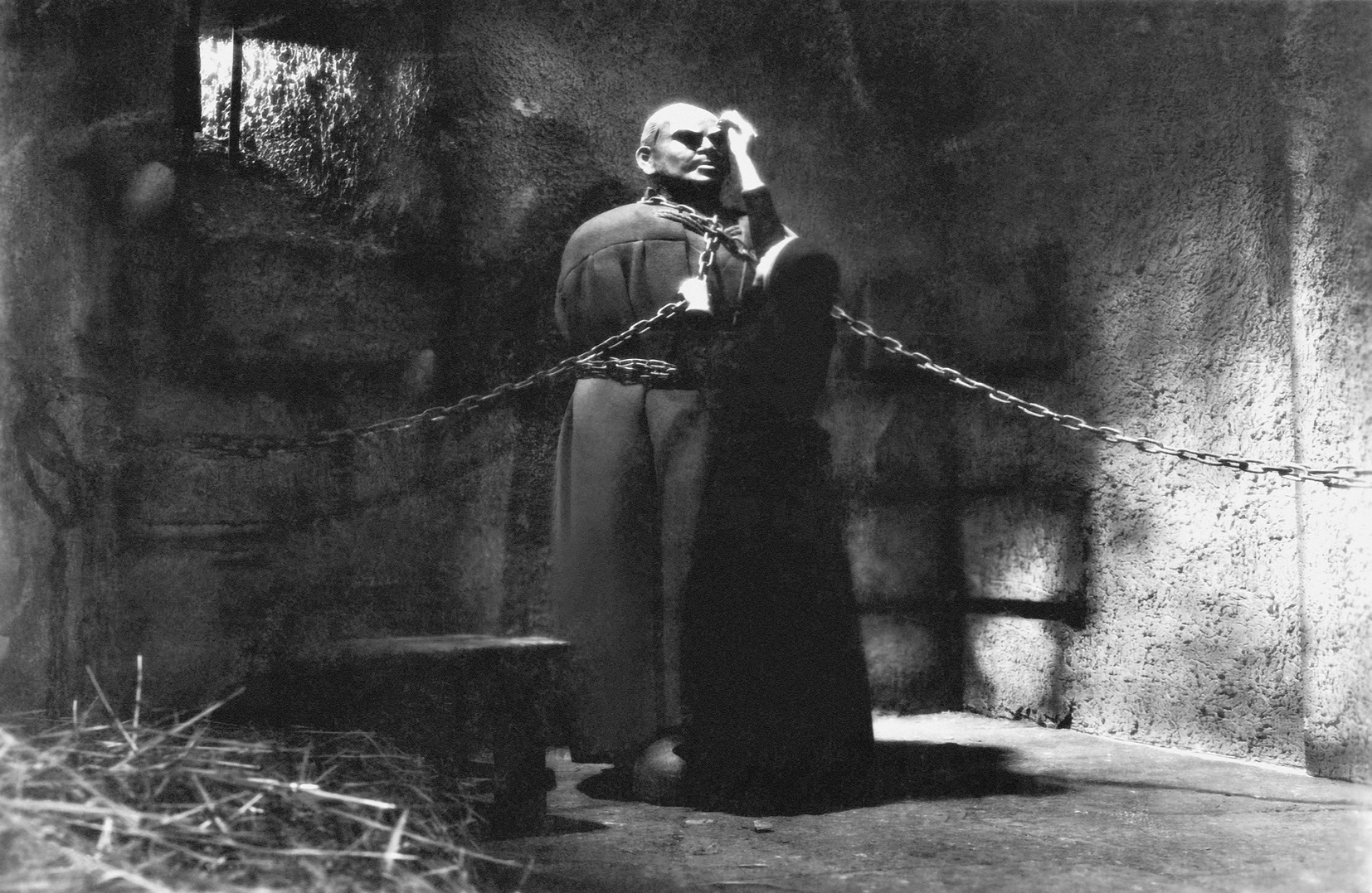
One of the many adaptations of Edgar Alan Poe's famed The Pit and the Pendulum, Czechoslovakian filmmaker Jan Švankmajer also merges it here with Auguste Villiers de L'lsle-Adam's A Torture By Hope for Kyvadlo, jáma a nadeje, (The Pendulum, the Pit and Hope). Though many movies have been made based around Poe's source material, there may not be another more visceral than this. Shot in grainy black and white, combining live action with stop-motion animation, and featuring POV camera work almost exclusively with no dialog or music, it presents a harrowing yet primitively stylized examination of mounting fear. There are three set pieces in just under fifteen minute and each one portrays a combination of certain doom,yet as the title would suggest, also hope. The set design is superb, particularly a mechanical fire and brimstone device that seems hellbent, (har, har), on sealing our protagonist's fate, a protagonist whose face is never shown to us and whose heavy breathing is the only sound we hear exiting their body.
GEOMETRIA
(1987)
Dir - Guillermo del Toro
Overall: GOOD
The tenth and to date last short film by Guillermo del Toro that has actually been released, Geometria, (Geometry), showcases the filmmaker's more comical side while simultaneously being as gruesome and macabre as ever. Based somewhat off of the short story Naturally by Fredric Brown and borrowing the classic, often used Monkey's Paw logic to hilarious effect, two versions of the movie exist with the director's cut actually being the shorter one that features a different score by Christopher Drake who would go on to do numerous animated film's including the two del Toro produced in the Hellboy series. In either edit, it is a solid pre-curser to del Toro's first full-length Cronos that would appear several years later, though again, much more on the funny side. The color schemes are straight out of Italian horror, (particularly and intentionally the likes of Mario Bava), and though it is more than competently shot, the low-budget make-up effects and gore still help give it a delightful, amateurish charm.
DEATH AND THE MOTHER
(1988)
Dir - Ruth Lingford
Overall: GOOD
This very sombre and chilling wood-etching animated short was the debut from British animator Ruth Lingford. It is a fairly close re-telling of the Hans Christian Andersen tale The Story of the Mother which was originally published in 1847, here titled Death and the Mother. The film as well as the original source material itself can be looked at in a number of different lights. An allegory for the sacrificial nature that any mother has to go through as well as the inevitability of death itself, (Death being personified both as a hidden, sudden presence as well as one that is wholly part of nature), it is an impressive feat for a mere ten minute, dialog-less movie to raise so many stimulating questions. Lingford's primitive animation style contributes rather ideally, flowing in a continuous fashion and bringing in yet another layer of how life and eventually death both move in such a linear, inescapable paths.
KITCHEN SINK
(1989)
Dir - Alison Maclean
Overall: GOOD
Another black and white, part avant-garde short film with a number of themes to dissect, it is a fair comparison to see Kitchen Sink as sort of a feminist answer to David Lynch's seminal Eraserhead, be it one that is not so much concerned with the fears of being a parent but more the fears and desires of being in a relationship to begin with. Though she was operating and living in New Zealand at the time, Canadian Alison Maclean, (who would go on to direct Natalie Imbruglia's "Torn" video which we all saw several thousand times on VH1 back in the late 90s), concocts a strange examination of female sexuality, boredom, loneliness and the way that men can be looked at as being horrifying, intriguing, and tantalizing from such a perspective. The ending can further emphasize how these toxic qualities can be reoccurring as curiosity and human nature ultimately get the better out of our two, unnamed characters who are frightened, turned-on, afraid of, and nurturing to each other throughout the minuscule running time.
Wednesday, July 10, 2019
1980s Foreign Horror Shorts Part One
(1980)
Dir - Joško Marušić
Overall: GOOD
A noteworthy short from famed Croatian animator Joško Marušić, Fisheye, (Riblje oko), is less than ten minutes, dialog-less, and rather to the point. Its simplicity in look and structure is due to Marušić being part of the Zagreb School of Animation which is meant to more heavily emphasize style through its limitations. This works well here where the lack of anatomically realistic bodies appear more blobby than anything. The humans have tiny heads with too many lines in their faces and the rest of them often seems massive in comparison, while the fish all vary in size depending on how menacing they are meant to appear. Utilizing a small array of colors, (mostly diluted greens, greys, and blues), the tiny fishing village is void of detail which helps make it both otherworldly and relatable as it could be happening virtually anywhere. If any humor is indeed present, it is dark enough to not notice, but still expressively done.
THE FALL OF THE HOUSE OF USHER
(1982)
Dir - Jan Svankmajer
Overall: MEH
Czech surrealist stop-motion animator and filmmaker Jan Svankmajer's vast filmography includes more than one foray into horror and this adaptation of The Fall of the House of Usher from the genre's most celebrated writer Edgar Alan Poe certainly qualifies. Featuring no on-screen actors, (only the narration of Petr Cepek), and deliberately grainy black and white photography, Zánik domu Usherú, (its original title), is a fairly interesting experience though not necessarily the most ideal one for the famous source material. Not that yet another adaptation of Poe's story need be made in a conventional sense, but most of the images in this fifteen-minute long interpretation seem unrelated to the actual story and are just kind of there to put something on screen besides any actual people. It works better when the narration does jive perfectly with the visuals, but elsewhere it is rather avant-garde for the sake of it and kind of distracting to follow the voice-over along with it.
THE PHANTOM OF REGULAR SIZE
(1986)
Dir - Shin'ya Tsukamoto
Overall: MEH
Some things are difficult to understand. While Futsû saizu no kaijin, (The Phantom of Regular Size), was not the first short or otherwise-lengthed film from Shin'ya Tsukamoto, it was the precursor to his most famous work Tetsuo: The Iron Man. Shot on 8 mm film and primitive in all of its technical details, this is essentially the exact same movie as Tetsuo, (down to even featuring the same lead actor Tomorô Taguchi), except mercifully condensed to a mere eighteen minutes. Hyper-fast, utterly nonsensical, poorly photographed, and above all else boring, it wastes no time in being a waste of time. Tsukamoto is well-respected in bizarro-world cinema, but his scatterbrained, bizarre, steampunk vision simply can easily go right over one's head. Being so identically styled as Tetsuo whose appeal is likewise tricky to wrap one's head around, this one here is equally for an acquired taste.
(1987)
Dir - Jiří Barta
Overall: GOOD
Another project from a prominent Czech animator, The Last Thefis is in fact the only live action film from Jiří Barta. Equal parts Gothic horror and silent film with a macabre twist right out of EC comics and some of the most atmospheric creepy mansion/creepy cemetery cinematography you are likely to see anywhere, The Last Theft has no need for dialog as the story makes its protagonist a caricature of cartoonish greed; one whose intentions are crystal clear via the wonderfully stylish way that Barta portrays everything. Primarily black and white with various color tints used throughout, (most of which give clues as to the emotional state of who is on screen as well as the significance of what objects are on screen), parts of the film are slowed down or sped up. This helps emphasize the strange setting which is both still like an old photograph and alive in only a ghostly fashion all at once. The film is also rather consistently amusing, intentionally so as the fate of our chubby, mustached thief can really only end up one way. Once the audience is let in on the spooky joke, it is a successful one to say the least.
Friday, August 3, 2018
2000s Foreign Horror Part Eight
(2002)
Dir - Olivier Assayas
Overall: GOOD
By its very construction, Olivier Assayas' Demonlover treads murky waters in its examination of matter-of-fact business negotiations as they pertain to dubious enterprises. Shot in both Japan and Assayas' native France, (with an international cast bouncing between three different languages), it unloads frequent surprises that seem to shift the subject matter if not the entire genre as it goes on. Being examined more closely though, Assayas fuses the erotic thriller, spy film, and dark web content into something with a singular agenda. The characters here are all just doing their jobs, which generally revolve around eliminating competing obstacles by the most efficient and non-emotional means. In this way, when things go awry and then venture into full-on disturbing territory, it maintains a chillingly calm demeanor which heightens the theme of desensitized morals in a corporate landscape. Connie Nelson, Charles Berling, and Chloë Sevigny, (the latter speaking phonetic French as convincingly as has ever been done), are ideally suited for the material, but Assayas' challenging script and its presentation which includes endlessly flowing, often hand-held camera work is what best keeps the material interesting, if not altogether decipherable at first glance.
(2005)
Dir - Jan Švankmajer
Overall: GOOD
An engaging, ghastly at times social commentary on mental instability and probably some other things, Czech animator/filmmaker Jan Švankmajer's Lunacy takes many a familiar ingredient and boils them quite well into its own stew. It borrows sporadic elements from Edgar Allan Poe and the Marquis de Sade, (both of whom have been the subject and basis of many a horror film), with Švankmajer himself introducing the movie directly to the audience in an opening scene that calls all the way back to Universal's 1931 Frankenstein. The weird, stop motion animation that the director is primarily known for is used multiple times with slabs of meat getting into all kinds of bizarre tomfoolery that is supposed to mean whatever you think it means. Time periods are excellently molded together, (one early scene has characters in period costumes ridding a horse and cart across a busy highway full of modern cars per example), and the lunatic asylum set up provides the perfect scenario for strange, diabolical set pieces. Though actually the best of these takes place earlier and is bound to bring a chuckle to anyone's face who is a fan of overt blasphemy.
DEAD SNOW
(2009)
Dir - Tommy Wirkola
Overall: MEH
What would be a fun, moronic zombie comedy here ends up being overshadowed by its own lazy screenwriting and many an obnoxious horror genre faux pas. Director Tommy Wirkola and actor Stig Frode Henriksen cannot keep the details of their story straight, which randomly does whatever it thinks is the coolest or funniest thing at that particular time instead of sticking to it's own rules. Cell phones do not work until they do, zombies lay dormant but then all wake up when it is dramatically "badass", they are zombies so they chase people and eat them until they want shiny gold trinkets instead, they are also soldier zombies so you would think they would not get wildly chopped up and incapacitated by a bunch of medical students, etc. There is also stupid hack elements like characters miraculously surviving numerous things that would have absolutely killed them and so, so many jump scares that get increasingly aggravating. Though the basic set up of young people in an isolated location with no cell phones needs to permanently be retired and the premise of Nazi zombies is something a twelve-year old would come up with and think is swell, they should still allow you to turn your brain off and enjoy yourself. Zombie burn-out is way too undeniable now though and dumb horror movie tropes halt the gory schlock of Dead Snow from hitting as hard and as funny as it should.
Tuesday, July 31, 2018
2000s Foreign Horror Part Seven
(2000)
Dir - F.A. Brabec
Overall: GOOD
Czech filmmaker F.A. Brabec's colorful, stylized adaptation of Karel Jaromír Erben's ballad collection Kytice, Wild Flowers, (not to be confused with the Eric Roberts drama Wildflowers that was released the same year), easily has enough supernatural elements to justify it as a horror-esque movie. There are five main stories and two others that act more as loose bookends, and most of the film is rather whimsical and poetic with lush music almost consistently played throughout, the only dialog being taken from the actual Kytice ballads. "The Wedding Dress" is the most classic horror example and a rather lively one at that. "The Waterman", "The Noon-Day Witch", and "The Golden Spinning Wheel" are pure fairytales and all of them possess one or two dramatically eerie moments that are quite fitting to the fantasy setting. The poems themselves are all based off of Czech folklore with a heavily religious thread throughout and Brabec more or less brings them to life in a rich, playful way. It is simple yes, but it works as an art film that is anything but drab and again, it has got plenty of fun little macabre bits to maintain any horror buff's attention.
THE BABY'S ROOM
(2006)
Dir - Álex de la Iglesia
Overall: MEH
Originally shown on television, 6 Films to Keep You Awake at Night was a Spanish mini-series of six individual movies, naturally all horror ones. The Baby's Room is one such entry and though it is certainly formulaic and not without its shortcomings, it nearly delivers on a creepy premise. A handful of moments are handled successfully, with a video baby monitor and a supernatural, psychological takeover proving rather sinister if not all together logical. The boo scares are annoying of course, which is a shame as they would actually be downright terrifying if they were not utilized in such a hackneyed, predictable manner. Removing the loud shrieking violin noise for one is a fantastic idea that very oddly nobody ever thought to do. Things get muddy by the end where the film fails to deliver on much of its mystery, refusing to tie-in many of its plot elements that ultimately seem to just be there because horror movies. The nimble, seventy-seven minute running time is refreshing in some respects, but it is also the reason everything seems rather rushed because well, it is. Álex de la Iglesia's earlier The Day of the Beast is a much more solid horror entry if one is looking to investigate any further, with The Baby's Room being more of a botched exercise.
COLD PREY 2
(2008)
Dir - Mats Stenberg
Overall: WOOF
Exhibit A for anyone who hates slasher movies. You know how Halloween 2 takes place in a hospital immediately after the first one? So does Cold Prey 2. You know how the first Cold Prey ends with a final girl moment where she murders the bad guy to death? So does Cold Prey 2, (same girl, same weapon, same location). You know how Michael Myers has inhuman strength and is always dead but then comes back alive no matter what happens to him? Same. You know how slasher bad guys always find a way to make all the lights stay off so they can kill the person who turns them back on right as they do so? Yup that is in here too. You know how the bad guy in slasher movies always get shot in the nick of time by someone you thought was dead just as they are about to kill someones else? Check. You know how when your bad guy in a slasher movie is left for dead but of course he is not dead and when the characters and camera turn their back on them, they vanish into thin air? Double check. You know how bad guys in slasher movies have opportune times to kill people but they put it off for several hours because it is more dramatic and way more stupid when they do? Yup. You know how the character you least expect to show up to save the day always shows up to save the day? Can we stop now?