Saturday, October 13, 2018

The Haunting

THE HAUNTING
(1963)
Dir - Robert Wise
Overall: ALMOST THE BEST

Another Halloween season means another truly remarkable horror film to go into deeper analysis on.  Working from the top down from my own initial 100 Favorite Horror Films list I did in 2012, I went into much detail about why The Shining is the greatest of all horror film's last year and this time it is Robert Wise's seminal The Haunting from 1963.  It is easily the finest black and white haunted house movie ever made and arguable to others besides me, the finest black and white horror film period.

Looking at The Haunting as an early 60s, British horror vehicle no different on a surface level than many others, it is in fact easy to claim it as the pinnacle of the medium.  If you consider that a mere five years later George A. Romero would unintentionally revolutionize the horror movie with Night of the Living Dead, The Haunting appears to be even more of a crowning achievement for its era.  Yet I for one would like to persuade that this is just as extraordinary of a movie now as ever.  There are so many meticulously crafted elements to its success that showcase a care and craftsmanship that any film made at anytime could not only take notes from, but also wholeheartedly admire.

What Night of the Living Dead had in grasping zombie hands, The Haunting had in holding them.

The Haunting is based of course of Shirley Jackson's 1959 novel The Haunting of Hill House.  American filmmaker Robert Wise caught wind of the book from a Time magazine review around the time that he was doing post-production on West Side Story.  Wise contacted his previous and continued collaborator Nelson Gidding to work on the script and by the time West Side Story was wrapped up, said script was finished.  This though was after both Wise and Gidding visited Jackson in person to discuss the novel and its intended adaptation and Gidding put together a full, detailed story treatment before spending no less than six months on the finished script.  So already from the film's infancy, there was very much a level of dedication in play to making it work.

Initially, Gidding wanted to interpret the novel as a woman's, (lead protagonist Eleanore Vance), descent into a nervous breakdown, having imagined all of the experiences in the story as she was actually suffering in a mental institution.  Of course taking this angle to a horror plot was nothing new and nothing that would not be done a liberal amount of times later.  Yet after the screenwriter and director's meetings with Jackson, the author confirmed that the story very much was about the supernatural and throwing such an "all in her head" twist on it may not be the most honorable route.  In the end, Jackson's feelings about her own material would indeed appear more reasonable, but one of the most successful things about the finished film is how it still toys with this mental instability angle to a beautiful, captivating degree.
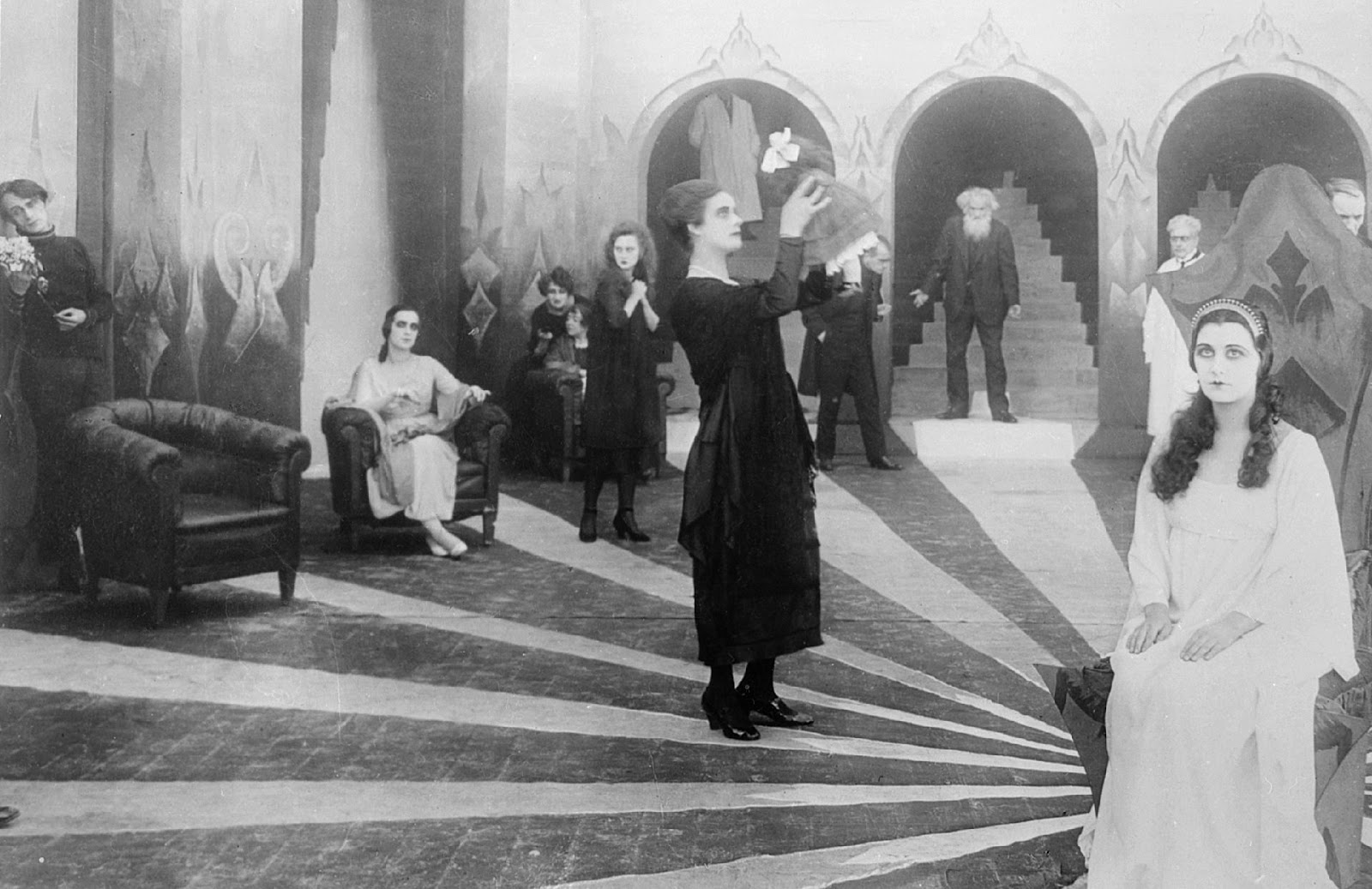
Horror movies set in insane asylums; as tried and true of a motif as any, going all the way back to 1920s Germany.

For nearly the entire film or at least once Eleanore is introduced to us, we are deliberately mislead as to what may or may not be actually going on.  Eleanore, (played by Julie Harris who "conveniently" one could say was suffering from depression in real life at the time), is a full-blown eccentric; a disturbed, lonely woman who spent by her own accord, "her entire adult life" caring for her "invalid mother".  Yet even as a child, there was something very special and very off about her.  In the book, Eleanore's backstory is naturally more fleshed out, but in the film, we are wonderfully given just a verbal snippet of her childhood episode where a sporadic shower of rocks fell on her house for three days with no explanation still.  This scene is staged excellently as Eleanore is clearly upset by Dr. Markway casually bringing it up in an early meeting, both denying and deflecting it in a tantrum-like manner, as she frequently does throughout the film.

What this means is that it definitely was a dark secret that she never wished to talk about and most likely has done everything in her power to deny even happened at all as she desperately continues to fantasize about being a normal person with a normal apartment with two stone lions sitting atop her mantelpiece.  Eleanor's obsessive narration of her own life and extreme defending of her idiosyncrasies says so much about why Hill House "wants her".  In her damaged mine, the house most definitely would favor her over any of the other occupants because something is at last "really, really happening" to her.  On the other angle, if the house really IS alive in a supernatural fashion, of course it would want the most emotionally wounded and viable person it could find to join it and walk amongst its walls.

Dancing with "nobody", she is a quirky one that Nell.

This is a brilliant move for any psychological horror overall; to constantly place the viewer in a seat where they are never crystal clear as to what's fabricated and what's real in the story they are presented with.  What Wise and cinematographer Davis Boulton and set designer Elliot Scott then contribute to this agenda is of the utmost importance as well.

The exteriors to Hill House are Ettington Park, (now a luxury hotel), in Ettington, Warwickshire, a sprawling mansion so creepy and ideal looking that even lead actors Julie Harris and Claire Bloom were hesitant to step foot in it in real life.  Everything else in the film was shot on a set at MGM British Studios that was consciously built in a Rococo style, with ceilings constructed to help make the movie more claustrophobic in nature.  To further emphasis this, the interiors were heavily lit without dark, stereotypical corners and an imperfect, 30 mm lens was used that literally stretched the finished frame in a distorted manner.  Other tricks are applied such as infrared film for establishing shots, unconventional pans and tracking shots, (when Eleanore runs into a mirror that the camera is fixated on and when she nearly falls backwards off a veranda as the camera dives towards her, per example), and sped up and reversed shots such as the ascension to the top of the library's bookcase.  Characters routinely get lost in the movie trying to navigate the enormous mansion's passageways and Wise also filmed actors leaving rooms from one side of the frame only to emerge from the same one, when the opposite technique is usually the standard case.  Shown from the inside, it is difficult to gauge what time of day or night it is and in one of the library scenes, both day and moonlight appear to be shining in at different angles.

Mind the falling camera...and your vertigo.

While the sense that the house is sentient and controlling or manipulated things could not be better expressed, it is nearly miraculous how very, very little The Haunting technically shows us.  We hear sounds, we see a few doorknobs move, and in the film's standout scene, a wooden door bends inward like a piece of foam.  Yet we see no ghosts anywhere.  Statures are continually shown clearly in frame and even lingered upon at particular times, every exterior shot of the house makes it look like the windows are watching us watch them, and the way every room is loudly decorated do everything they can to make us feel anything but at home in the place.  The characters are rarely comfortable and even when they are, they seem to be putting on a face as to not let the house know what they are really thinking.

This brings us to Theodore, one of the small cast of characters yet a hugely important one.  As Eleanore seems delusional and dancing around in her head, Theo is presented to us as a psychic and at various times she seems to be reading and messing with Eleanore's cracked psyche.  She easily preys on her emotions, (sometimes playfully and sometimes not), be it Eleanor'es guilt surrounding her mother's death, her fabricated story of her own apartment which Theo appears to be just humoring her to listen to in the first place, her growing infatuation with Dr. Markway, and even Markway's own increasing concern for Eleanor's well-being which Theo sees as a threat to herself, being an unspoken lesbian character.  All of these feelings are playing off of each other and again, whether the house itself is eating them up to achieve its diabolical goal or Eleanore is making them all happen the way she likely made those rocks fall from the sky on her dysfunctional home as a child, the viewer is left to wonder and be equally on-edge.

That "Seriously?" face you make when the doors randomly turn into rubber.

Speaking of on-edge, The Haunting's sound design is another of its perfect ingredients.  The music was done by English composer Humphrey Searle and the way that it is almost deafening at times is on the long list of ways the film makes us feel distressed.  Eleanore's narrations are virtually always accompanied by a variation of the same piece of somber, nervous violin music as if to say that just as she cannot help speaking to herself in her own voice, the distressing music cannot help to be there with it so we know that this is a constant, uncomfortable strain in her life.  It does far more than just establish that "something scary is going on".

Wise uses the music so consistently that it becomes another living and breathing element to Hill House, making the movie's occasional, completely silent segments that much more frightening.  The music often stops when Eleanore is actually asleep, yet again this is a brilliant move to subliminally tell us that everything could actually be revolving around her active imagination.  Like any good horror movie moment though, deafening silence is far more terrifying than anything else and all of the film's scariest scenes are played to no dramatic music.  This is incredibly important because we truly see what the house and/or Eleanore's supernatural abilities are trying to do; when the noise stops, the evil forces can really hone in and find what they are looking for.  Eleanore frequently says and thinks that the house is trying to locate her and just wants to bring her home, so as Mrs. Dudley humorously says like a broken record, "in the night...in the dark" is when the search really begins and all of the suffocating doom around everyone really attunes itself.  While assuredly creeping us out in the process.

"Creeps us the fuck out" to be more specific.

So again, WISEly, (yuck, yuck), Robert Wise and his whole creative team never let on explicitly what is indeed happening in The Haunting and the film is infinitely more amazing for doing so.  I have lost count long ago how many times I have watched this movie and never once have I viewed it where I do not began to question more things.  For a film over five-decades old that was made near the tail-end of horror's golden age, it is beyond impressive how much it perfected everything the film medium was capable of at the time and still continues to impress.  So many innovations for both better and worse have come from the genre since this movie was unleashed to the public and plenty of exceptional movies in it continue to be made.  Yet The Haunting stands as an absolute peak, doing everything a spooky haunted mansion movie can possible do and more.  I will hold it in this regrade presumably for the rest of my days and during all of the inevitable further viewings I partake of, it will unlock more and more doors and remain the masterpiece it always was.

Now, who wants to plan a fun vacation?

Thursday, October 11, 2018

2018 Horror Part One

A QUIET PLACE
Dir - John Krasinski
Overall: WOOF

The Office's John Krasinski took on A Quiet Place, working on a spec script before re-doing some of it and ultimately getting his wife Emily Blunt on board.  Yet with everyone's powers combined, it is an absolute failure.  The premise basically sets up all the pieces for this to be Boo Scares - The Movie.  So in utilizing arguably the very, very most despised cliche in all of horror cinema as its main selling point, (big) strike one.  As the story continues on its way though, crater-sized plot holes begin sprouting up though.  Anyone who can watch this movie without constantly being taken out of it by asking very logical questions like "wait, what?", "wait, why?", "wait, isn't...?:, "wait, I thought...?", and so on and so on is too busy either texting on their phone or eating popcorn.  Then to top all of this off is cringe-worthy ending, completely lazy, generic-as-can-be cartoon monsters, and maybe the worst sound design in all of motion picture history.  It was clearly meant to be relentless in its construction, but all of that tension-building is simply wasted by, well, every single other thing about it.

UNSANE
Dir - Steven Soderbergh
Overall: GOOD

A filmmaker as prolific as Steven Soderbergh has more than dabbled with some thrillers in his career, but Unsane comes the closest so far to being a bona fide horror movie, be it one without any supernatural elements anywhere.  It mostly achieves its objective to be rather heart-racing.  From a psychological standpoint, Soderbergh and screenwriters Johnathan Bernstein and James Greer take awhile letting on what is actually happening.  Though keeping us in the dark for the first act does not wield any amazing twists or anything later on, it does create the necessary mood to make us ultimately sympathize fully with the plight of Claire Foy's Sawyer Valentini.  Foy is rather top-notch here, (the occasional British accent slip notwithstanding), being as helpless, logical, unhinged, and fierce as she needs to be.  The script is a bit too forced at times though, with some monologues and character exchanges coming off rather overtly screenplayey.  The only real problem with Unsane is in some of the details to the situation that are a bit too unrealistic to buy into.  Without getting into spoilers, how those that are fucking up Sawyer's week are managing to get away with it is stretched thin enough to notice some plot holes.  Still, for Soderbergh to indulge himself a bit by essentially shooting a B movie on an iPhone 7 Plus, he gets away with it as the student film look and presentation is more interesting than not.

HEREDITARY
Dir - Ari Aster
Overall: GREAT

It certainly says something positive that several landmark horror movies readily come to mind when viewing Hereditary, another astounding debut, this time from New York filmmaker Ari Aster.  Masterfully constructed and anything but a pandering throwback, cinematographer Pawel Pogorzelski deserves a standing ovation for his contribution to the film's suffocatingly menacing mood.  There are layers to this movie that require several viewings to expose and the deliberate misdirection that Aster utilizes make it as suspenseful as possible while keeping its mystery thoroughly satisfying.  A film this dramatically powerful would be a disaster if not for top-notch performances which it has across the board.  Far more than she even did in her star making turn in The Sixth Sense, Toni Collette is superb as an emotionally destroyed, mentally damaged mother, yet Gabriel Byrne, Alex Wolff, and Milly Shapiro each rounding out the family are also pitch-perfect in their respected roles.  To give the film a few strikes for a single boo scare or a rather standard, contemporary horror soundtrack is probably fair, but so, so much is done exactly right that its status as an instant masterpiece is equally just.

Tuesday, October 9, 2018

2017 Horror Part Five

ALIEN: COVENANT
Dir - Ridley Scott
Overall: MEH

While certain aspects have improved with Ridley Scott's second Alien franchise boost Alien: Covenant compared to Promethius, oddly others have declined.  Overall the film is better and far more compelling, with several well-rounded characters that are written solid enough to actually care for.  Primarily though, it is the arc of David 8 and the always exceptional Michael Fassbender's dual role as both he and Walter One, a rather "good brother/bad brother" paradox that works quite well in this context, (even if the film's "twist" regarding him is so readily apparent that it could even be argued that it was not meant to be a "twist" at all).  Naturally, it is Fassbender's performance that is mostly to praise and this is another prime example of how he could easily be considered one of the very best actors working this century.  As far as the stumbles, Covenant still adheres to the same set up where a crew of space marines check out a planet and encounter/get infected with the alien virus bug thing and at this point it is a bit impossible to really garnish any suspense whatsoever out of it.  The CGI is embarrassing looking and an obvious step down from Prometheus, which is quite odd in the first place coming from such a major-budgeted movie such as this.  Also, there is a lack of H.R. Giger design influence for this one, which was always nearly the very best part of any Alien movie.  Still, Fassbender kills it so it is probably not worth missing just for that alone.

THE EVIL WITHIN
Dir - Andrew Getty
Overall: WOOF

Despite featuring the always wonderful Michael Berryman in as creepy a role as ever, The Evil Within is a trainwreck of a film with an odd backstory.  Oil heir, businessman, and eccentric recluse Andrew Getty decided to write, fund, and film The Evil Within, (at first called The Storyteller), mostly in his own mansion, on and off for upwards of fifteen years.  Cast members dropped out along the way and at the time of Getty's death, the movie was still unfinished and editor/producer Michael Luceri stepped in to finally wrap it all up.  The result is the strange work of an amateur filmmaker that simultaneously shows flashes of both a large budget AND a limited one.  Numerous location sets that were most likely on Getty's own property look peculiarly designed, (including one outdoor restaurant that the characters visit upwards of six times).  The stop-motion special effects though are often very elaborate and could perhaps distract one from how poorly written, acted, and structured the movie is.  The numerous flaws end up "winning" this battle in the end though.  Before the ending very much spirals into ridiculous oblivion, the movie is borderline agonizing to sit through.  Whether Frederick Koehler is endlessly monologuing in a "normal" voice or a stuttering one as a slow person who asks "why?" after every sentence his split personality says, the dialog is terrible all the way through.  The story both drags and appears rushed, coming off as barely coherent in the end.

GHOST STORIES
Dir - Andy Nyman/Jeremy Dyson
Overall: GOOD

Though it essentially amounts to an Amicus anthology horror throwback, Andy Nyman and Jeremy Dyson's film adaptation of their own stage play Ghost Stories has enough rewarding elements going for it.  Each of its supernatural-laced stories are tweaked ever so slightly to differentiate themselves from each other.  The first involving a night watchmen is the most straight-forward, while the second involving a high-strung teenager out for drive is the funniest, and the final wherein Martin Freeman finally shows up is the most bizarre.  Nyman and Dyson still regrettably structure most of their scares around the spooky music + things get quiet = tension releasing noise/visual, but there are a couple of interesting and well done moments that step out of this cliche, moments that should not go upraised.  The final act of Ghost Stories is effectively unexpected, but it also gets kind of messy and generic from a plot twist standpoint.  Still, both the familiarity and handful of exciting adjustments to the genre ultimately make a fun experience as opposed to a pointless, (or worse yet), insulting one.  It is a very rare example of a retro-styled, modern day horror film that rides the line of both being a deliberate homage while at the same time steering the genre just a tidbit into some new ground.

Sunday, October 7, 2018

2016 Horror Part Seven

PREVENGE
Dir - Alice Lowe
Overall: MEH

Tones clash rather wildly in Alice Lowe's directorial debut Prevenge, a film whose pun title itself gives away its premise.  As a comedy, the movie is fine not only in being funny just on paper, but in a number of pretty amusing scenes, the best of which involves a visit to Game of Throne's Gemma Whelan's flat, (other GOT alumni and The Witch actress Kate Dickie also makes an appearance).  The problem with Prevenge is a frequent one though.  Lowe, (who also wrote and stars in the lead whilst real life pregnant during filming), dips her toes into serious drama involving her severely grieving title character, but this conflicts with the comedy quite a bit.  It is another case of trying to be a dramatic character study while having as many laugh out loud, borderline slapstick moments as possible.  All the while, it gets bloody and nasty a fair amount of the time, fully deserving of its horror genre tag.  One cannot argue that the movie is not enjoyable though.  It moves at a brisk pace and even though the combination of its elements are contradictory to a fault, they are pleasing enough on their own.

RAW
Dir - Julia Ducournau
Overall: GOOD

In the last two decades, France has been responsible for a large number of repugnant, bottom-barrel horror films in the form of the New French Extremity movement and on a surface level, Raw appears to fit into this deplorable sub-genre.  Thankfully though, that is only how it appears as Raw very thankfully removes itself from something purely disturbing and torturous to watch for the ridiculous sake of it.  Writer/director Julia Ducournau has certainly crafted something uncomfortable with plenty to flinch away from yes, but there are some intelligent themes being explored that can almost be looked upon as being profound.  Vegetarianism, peer pressure, and sexual awakening are some of the things transmuted here and Ducournau wisely keeps most of the information somewhat vague and ultimately rather unimportant.  This is because at its core, Raw is mostly an exploration of its subject matter far more than being just a straightforward narrative.  The cast is particularly strong as well and many would probably agree that Garance Marillier, (a teenager at the time of shooting), is the most exceptional as Justine with Ella Rumpf trailing close behind as her just-as-wacky sister Alexia.  If more films with gross-out visual elements went to the lengths that this one does to actually make their distressing nature meaningful, then the whole of French horror cinema could certainly benefit.

THE BELKO EXPERIMENT
Dir - Greg McLean
Overall: MEH

Ruined in part due to the trailer showing virtually every last detail that happens, The Belko Experiment does not really offer much in the way of suspense once you know what it is about.  Written by James Gunn early on in his career but shelved for a number of years, Wolf Creek and Rogue director Greg McLean ultimately took it on and the result is pretty straight-forward and textbook.  Gunn's script sprinkles humor pretty leisurely around, (naturally), but the balance between disturbing subject matter and what the audience is meant to chuckle at to ease the tension is kind of hit or miss, depending.  Performance-wise, everyone is pretty on point and everything is probably dealt with as reasonably as possible given the character's hopelessly dire circumstances.  That said, all of the characters are underwritten, some jarringly so.  A movie as tense as this is really building up to a satisfying climax though and that is definitely not what we get.  Not to spoil it further, but the final line in the movie is more embarrassing than cool and the point of everything is left frustratingly barren.  It is a formulaic conclusion and rather one-note for the near hour and a half proceeding it. 

Friday, October 5, 2018

2015 Horror Part Seven

NINA FOREVER
Dir - Ben Blaine/Chris Blaine
Overall: MEH

Partially Kickstarted, writer/director/editor brothers Ben and Chris Blaine's Nina Forever is more interesting in premise than it is in having any kind of coherent payoff.  The film tackles the concept of moving on from grief and a previous relationship and the hangups that come from such a thing for both parties.  It essentially goes literal in how sometimes old lovers simply will not stay gone.  What it all ends up meaning to the characters involved is left frustratingly incomplete though.  It is very difficult to grasp what it is we are exactly supposed to get out of Nina Forever, even naturally taking into account that different audiences will theorize different things.  Though some could argue that the movie's ambiguity makes the film more intellectual, it does come off a little too underwritten and the characters are perhaps too eccentric to really relate to.  If that is even the point.  The comedic moments work less than they should and the film is really at its best when exploring the grieving process of the title character's parents compared to the main arc.  It is an impressive effort though and one that could easily prove more rewarding on future viewings.

DEATHGASM
Dir - Jason Lei Howden
Overall: WOOF

One can at least recognize visual effects artist-turned director Jason Lei Howden's Deathgasm as being deserving of a particular audience who likes their horror really, really moronic.  Equal parts Teenage Metalhead Cliches - The Movie and self-aware, slapstick gorefest, Deathgasm revels in its stupidity, poking fun at itself while pummeling you with bodily fluid jokes, gallons of blood, and more dull horror/teenage comedy tropes than you can wave a dildo at.  Equipped with one of the dumbest scripts ever written, the movie's attempts at being funny and clever are so juvenile and generic that it is more obnoxiously eyebrow-rolling than entertaining.  The movie is insulting beyond your standard, cynical nitpicking though.  A big, loud, gross splatter-ride like this is deliberately one-note, but Deathgasm is just too goddamn imbecilic to get into.  Again, the whole "metal + horror = badass" scenario is incredibly irksome and when characters describe their love of metal as being because nobody likes them in school and they fantasize about being Manowar clad barbarians who can moisten women with their ax- slinging abilities, you can only shudder at the laziness of it all.

BONE TOMAHAWK
Dir - S. Craig Zahler
Overall: GREAT

A quite excellent debut from director/novelist S. Craig Zahler, (who works from his own script), Bone Tomahawk is a brutal, near-perfect realist Western.  There are a slew of recognizable faces, (Kurt Russell, Matthew Fox, Patrick Wilson, David Arquette, Sig Haig, and even Sean Young and James Tolkan in cameos), and the performances are rather superb.  Russell and Fox particularly are fantastic and they are helped immeasurably by Zahler's incredibly good, naturalistic dialog.  Every character in the film behaves especially rational and in a lesser filmmaker's hands, it almost would have came off as comedic how logical and polite everyone routinely is.  There are elements of comedy to be sure and that is really the only area where Tomahawk falters a bit.  Some of the jokes seem very out of place considering the incredibly dire and hopeless, (let alone highly disturbing), situations these people are in.  To give Zahler credit, perhaps playing every frame of the movie in the utmost seriousness would have made for too depressing of an ordeal, but everything else is so expertly done that this is a small complaint if anything.  It barely registers as a horror movie nor does it need to and even some of its more cliche "scary" sound design gets an explanation from the script, yet another thing Zahler displays the expertise for caring about.

Wednesday, October 3, 2018

2014 Horror Part Nine

SHREW'S NEST
Dir - Juan Fernando Andrés/Esteban Roel
Overall: MEH

The predictable, bloody, and bleak Shrew's Nest, (Musarañas in its native Spain), is the debut from the director duo of Juan Fernando Andrés and Esteban Roel, both having made three shorts beforehand.  Agoraphobia, Catholic guilt, Stephen King's Misery, and severe, horrifically unwholesome family dysfunction go head to head in a single Madrid flat and things get more depressing than interesting as it all reaches its violent, inevitable conclusion.  Because it is very conventionally structured as a psychological thriller, (with twists, nightmares, and hallucinations a plenty), there is not much of a unique payoff though you cannot say that it is not expertly performed.  Macarena Gómez, (Dagon), is over the top in the emotionally distressing lead, but adequately so and the monstrously-eyebrowed Luis Tosar, (Sleep Tight), is yet another diabolical presence, doing what he does best.  Andrés and Roel may be sticking to a tried and true formula here, but the tone stays in check with only maybe the final showdown riding the line of illogical horror movie silliness ever so much.  It is certainly heavy in many areas, but understandably has an audience for those who enjoy competent, blood-soaked carnage.

SPRING
Dir - Justin Benson/Aaron Moorhead
Overall: GREAT

A solid case can be made that often times the best horror films only just happen to be horror films in an off-hand manner.  Meaning that they utilize certain genre aspects simply to enhance what is otherwise an already compelling and moving cinematic experience.  Justin Benson and Aaron Moorhead's second collaborative full-length Spring is a strong example of this.  It is essentially Before Sunrise with...something extra.  The way that the horror elements are presented are perfect, meaning they appear naturally and unexpected and the film never lingers or depends on them.  When an explanation is finally given, the writer/director team pull off a downright amazing trick in that it almost seems illogical or even goofy.  Yet by the movie's final, fantastic scene before the credits hit, all of the emotional impact truly sets in and the the plotty details barely seem to matter.  This will depend on the viewer of course, but Spring ends up being a genuinely powerful film and its romanticism is easily justified.  It is really just a plus that every shot looks beautiful, the performances are superb, and that it is so completely unique as a horror movie in general as there is not a single, solitary worn-out genre trope to be found.  Yet again, it is much more than that.

THE EDITOR
Dir - Adam Brooks/Matthew Kennedy
Overall: MEH

Astron-6, (Adam Brooks and Matthew Kennedy), follow up their revolting and absurd Troma-romp Fathers Day with the far, far scaled-back and far better looking The Editor.  Whereas their previous effort had all the amateur filmmaking trappings of a typical Troma production, they utilized their wildly larger budget here to make a throwback giallo, equipped with intentionally bad dubbing, zooms, a synth soundtrack, and a bright Argentoian color scheme.  The references to the Italian horror sub-genre are playfully sprinkled everywhere, (there is a book called The Three Mothers that makes an appearance, as well as Udo Kier himself), but The Editor does go for a far more ambitious plot in an attempt to elevate it over being a mere pointless, nostalgic rehash.  The problem there lies in just how ambitious the film tries to be as it collapses under it's weight.  The story increasingly goes off the rails, but the insistence on tongue in cheek silliness actually ends up getting in the way of the pretentious and macabre story.  Its potential to be an actual interesting and creepy supernatural giallo is undermined by its inability to take itself serious enough to stop being juvenile.  Or if you come at it from the opposite angle, all the atmospheric and weird horror elements hamper it from being just a moronic, over the top parody.  The Editor tries to have both and just comes up short, making the experience a little awkward and frustrating.

Monday, October 1, 2018

2013 Horror Part Six

EXTRAORDINARY TALES
Dir - Raul Garcia
Overall: GOOD

Spanish animator Raul Garcia combined several shorts along with a linking segment together to make Extraordinary Tales, yet another Edgar Allan Poe anthology.  Though Garcia directed and adapted each story himself, the digital animation style of each one is considerably different and all of them lend themselves appropriately to Poe's Gothic, macabre material.  Naturally, some are better than others with probably "The Pit and the Pendulum" and "The Facts in the Case of M. Valdemar" making the best impression and "The Fall of the House of Usher" and "The Masque of the Red Death" trailing a bit farther behind by comparison.  The most pleasantly surprising though is "The Tell-Tale Heart", due to it being narrated by none other than Bela Lugosi over a half-century since his death.  Lugosi's dramatic reading was presumably taken from a 1947 radio broadcast, but along with the props deserved to Garcia for scoring it here, he also manged to get horror heavyweights Sir Christopher Lee and Guillermo del Toro on board for further narrations.  The whole is pretty consistent, though the only complaint one could launch at it is due to the overwhelming familiarity with the material at this point.  All of the stories are iconic in Poe's catalog and have been adapted numerous times by now and Tales inadvertently becomes just slightly unengaging because of this.

PROXY
Dir - Zack Parker
Overall: MEH

Badly written and badly acted, Zack Parker's to-date latest feature Proxy pulls off once nifty surprise, but blows any and all of its potential everywhere else.  Just shy of halfway into the movie, something genuinely unexpected happens and up until that point, you could assume that Parker knew where he was going with the material.  Yet what follows this scene simply leaves all of its proposed questions dangling in the wind.  There are very disturbing events that go down in Proxy and more than one main character seems to posses layers to their psyche and motivation that the film itself only poses to you before moving on to something else.  The script is terribly illogical and it is the reason that Parker's would-be ambiguous story comes off sloppy and incredibly underwritten.  We are simply left thinking "well, I guess these people are just crazy".  It is hard to give a shit when the shits were not given to really dive into what is going on here.  The cast unfortunately does more to get in the way than not.  Joe Swanberg, (who has been rather stiff in a number of sub-par indie horror movies this century), is the biggest problem probably, but there are more peculiar, unconvincing line readings from the rest of the cast as well.  Everything seems off and unfinished and it is a tad insulting since there are some highly unpleasant visuals here that end up being totally not worth sitting through in the end.

THE RAMBLER
Dir - Calvin Reeder
Overall: MEH

A very confused, unfocused road movie, Calvin Reeder's The Rambler is a near textbook offender of style over substance.  It is filled top to bottom with meaningless, random dialog, emotionless characters, and freaky, unexplained visuals, but unlike a master like David Lynch per example, Reeder seems utterly lost as to what to do with all of his ingredients.  They are simply there to look at and listen to with absolutely zero attempt made to validate their inclusion.  Dermot Mulroney in the lead is so impassive to everything that happens to him that if he seems completely unmoved by it all, why shouldn't we also be unmoved?  The film's humor is dry to an absolute fault.  Mulroney meets people and walks into towns were arbitrary, horrifying things go down and in every instance he eventually just gets bored and picks up his guitar to walk off onto the next encounter.  It is not just that there is something missing to all of this; there seems to be EVERYTHING missing to it.  Either pushing the silliness or the horror elements further and having any relatable or natural characters present at all could have put things in some kind of penetrable framework, but The Rambler, (appropriately to its title), just rambles along and becomes all but offensively boring by the end of it.