Saturday, November 9, 2019

2000s Asian Horror Part Seven

A TALE OF TWO SISTERS
(2003)
Dir - Kim Jee-woon
Overall: GOOD

Some of the details are imperfect to A Tale of Two Sisters, (Janghwa, Hongryeon), Kim Jee-woon's adaptation of the frequently-filmed source material that is based off of Korean folklore.  Consistently moody, beautifully photographed, and making good use out of a few select, hair-raising set pieces, even if the obligatory boo scares are structured around drawn-out sequences of almost total silence, as is the norm.  Jee-woon still cannot avoid using "girl with long hair hanging over her face with a crooked neck" ghost cliches, yet these moments are handled uniquely, with more time being taken to sustain dread as opposed to endlessly showering the audience with familiar, lazy tropes one after the other.  On that note, the running time feels cumbersome and the twist is hardly the most revolutionary out there.  The last twenty-odd minutes do more to muddle the previous hour and a half than to satisfyingly expand upon it, but the film delivers enough unnerving manipulation to ponder the whole ordeal long after it is over.
 
GIDAM
(2007)
Dir - Jung Bum-shik/Jung Sik
Overall: MEH

It is a shame that the debut Gidam, (Epitaph), from the Jung brothers is so nebulous from a narrative perspective as it is simultaneously refreshing from a stylistic standpoint.  An anthology horror film that does not reveal itself as such until nearly halfway in, its lackadaisical way of shifting through timelines, spontaneous dream sequences, hallucinations, and different character arcs and perspectives, (which all hing around a hospital during World War II), is endlessly frustrating.  By morphing through everything that may or may not be happening on a physical plane, (let alone trying to follow several different plot points), the movie only stays lost in its nostalgic and tragic musings on loss, love, and regret.  Despite their murkiness, the powerful themes are expressed in a visually superb manner with Yoon Nam-joo's rich cinematography being a star of the show, followed closely by the period set design and the Jung brothers Bum-shik and Sik's vast array of images that bounce between unsettling and beautiful.  Most of the film plays to stark silence which gives it a haunting sense of suspense, yet unfortunately this is interrupted by Park Yeong-ran's overly-sappy orchestral music at irregular intervals.
 
THE FORBIDDEN DOOR
(2009)
Dir - Joko Anwar
Overall: GOOD

This slick adaptation of Sekar Ayu Asmara's novel The Forbidden Door, (Pintu Terlarang), from Indonesian filmmaker Joko Anwar fuses together David Cronenberg's Videodrome and David Lynch's Lost Highway, with a dash of John Carpenter's In the Mouth of Madness thrown in for good measure.  By Anwar's own admittance, it examines the fetishization of parenthood and namely how certain couple's can be accused of starting a family more in order to fit properly into a societal norm than out of an innate, nurturing desire.  The movie takes an approach that is on-the-nose for the most part, though it disguises itself as being more psychologically dense.  Setting up the forbidden door of the title early on, it dangles said carrot for both Fachri Albar's troubled protagonist and for the audience, so that we all know that the climax will revolve around what answers will be given therein.  This twist is easy to spot, but it is still delivered with an emotionally unsettling payoff that fits the rest of the film's boldness.  While the ride is fun and punctuated by interesting, tonally bizarre choices that give it an appropriately heightened sense of non-reality, the ending unwraps everything in a manner that leaves the viewer with nothing to further contemplate.  So even though it is less intellectually challenging than it may promise at times, it is quirky and brutal enough to keep one's interest before the credits roll.

Wednesday, November 6, 2019

2000s Asian Horror Part Six

DARK WATER
(2002)
Dir - Hideo Suzuki
Overall: MEH

A return to J-horror for director Hideo Suzuki after the one-two punch of the ridiculously successful Ringu and Ringu 2, Dark Water, (Honogurai mizu no soko kara), is unfortunately messy and formulaic.  An adaptation of a Koji Suzuki short story of the same name, it is predictable from frame one and relies exclusively on illogical, "because horror movies" tropes for its scares.  The film consistently poses the question as to why a ghost would behave the way that it does, (meaning that the supernatural forces here act exclusively in an arbitrary manner to stretch-out the running time), which does not even take into account things like characters standing completely still while scary shit slowly happens in front of them.  Lazy by conventional means then, such a process can still wield entertaining results and on a surface level, there is a creepy enough ambiance here to please genre fans, but it is by-the-books to a fault.
 
DEAD FRIEND
(2004)
Dir - Kim Tae-gyeong
Overall: MEH

Turn of the century K-horror and J-horror adapted many of the same motifs and in this respect, Dead Friend, (Ryeong, The Ghost), sticks to the formula without being entirely pointless.  Serving as the debut from South Korean writer/director Kim Tae-gyeong, it comes right out of the gate with a scenario that we have seen countless times before of a group of high school girls conducting a seance out of boredom, which naturally leads to a supernatural death.  Things become more interesting once the timeline jumps ahead where one of them, (Kim Ha-neul), is now in college and has suffered an amnesia spell as well as having acquired a completely different personality in the process.  This and various other hints are in place to set up the twist ending which is effectively done even if it seems obvious in hindsight, but the bulk of the film is delivered in a bog-standard manner for better or worse.  The ghostly apparitions are of the "long black hair hanging in front of the face" variety, all of the scared are predictably broadcast, and the vengeful spirit plot has various characters getting picked off while the main protagonist tries to unlock the mystery and set things right before she suffers the same wrath as her friends.

RAMPO NOIR
(2005)
Dir - Akio Jissoji/Atsushi Kaneko/Hisayasu Satō/Surguru Takeuchi
Overall: MEH

With four filmmakers teaming up, (including Ultraman director Akio Jissoji and manga artist Atsushi Kaneko), to each adapt a work by Japanese horror author Edogawa Ranpo, it is remarkable how terrible most of the result are.  Over two hours in length, not one of the four stories is either comprehensible or engaging.  The shortest segment "Mars Canal" that starts everything off is a pretentious art film with barely any sound and just features naked people doing things in slow motion.  The other three seem like they each last a century and maintain the same lackadaisical approach.  The stories are frustratingly vague, making it impossible to pick up any possible humor or dread in any of them, if any such things were even supposed to be there in the first place.  Instead, everything comes off as needlessly indulgent and occasionally disgusting.  Though the movie fails to work due to its treacherous pacing and impenetrable scripts, it is at least photographed excellently and has a unifying tone that unites each director's vision together seamlessly.  It is just a shame that it is wasted on such a boring, boring movie that is in the arthouse vein for the mere sake of it.

Sunday, November 3, 2019

2000s Asian Horror Part Five

THE EYE
(2002)
Dir - Danny Pang Phat/Oxide Pang Chun
Overall: MEH

The most well known effort from the Pang brothers and the first in the The Eye series, The Eye, (Seeing Ghosts), is a promising yet ultimately tame, unoriginal supernatural yarn with some consistent problems.  It can fairly be seen as the Hong Kong/Singapore answer to The Sixth Sense, minus any kind of twist or even remotely frightening set pieces.  The lack of spookiness is a major problem since it is actually a ghost story, but since the audience is fully aware of what it takes the characters far too long to discover, it remains unengaging by the time that the movie starts to answer its own questions.  The climax seems abrupt at best and sloppily handled at worst, plus the movie still tries to present itself as an uplifting tale with a happy ending.  The awful, warm piano music that continually reemerges also conveys a safe mood that plays its part in making the film even less potentially scary than it already is.  The performances are adequate and the horrible digital effects get a pass due to the era and moderate budget, but not enough is done with the material to make it stand out.
 
DOLL MASTER
(2004)
Dir - Jeong Yong-ki
Overall: MEH
 
A South Korean revamp of the type of killer doll movies that were churned out here or there throughout the 1980s and 90s, Doll Master, (Inhyeongsa), is less intentionally schlocky than the Charles Band productions that influenced it, adhering to bog-standard scare tactics and a dour tone.  The directorial debut from Jeong Yong-ki, (who also penned the screenplay), it has many familiar motifs at its disposal, with a common enough premise of several strangers who have been invited to an isolated mansion where strange things begin to occur.  We also have a "vengeance upon the descendants" angle that gets divulged in a silly expository dialog dump during the third act, making sure that every audience member is crystal clear as to what has been going on.  The presentation is both bloated and monotonous at times, particularly where Lim Eun-kyung's mysterious Mi-na character is concerned, who repeatedly stares longingly at Kim Yoo-mi with her enormous eyes while fighting back tears.  Some of the set pieces are gruesome and inventive, (like a girl who gets mutilated in a bathroom stall that has a life-sized doll hovering over the toilet bowl), but the story tries to be more profound than it actually is and the whole thing overstays its welcome after awhile.
 
MUOI: THE LEGEND OF A PORTRAIT
(2007)
Dir - Kim Tae-gyeong
Overall: MEH

A notable footnote for being the first produced Vietnamese horror film following the fall of Saigon as well as the first Vietnamese movie to receive a rating, Muoi: The Legend of a Portrait is actually a co-production between that country and South Korea, serving as the second full-length from director Kim Tae-gyeong.  Though it boasts effective atmosphere and performances, both the story and presentation strictly adhere to derivative J-horror motifs as well as the hackneyed trope of characters witnessing supernatural events and never mentioning them to a single soul; a trope that spans generations of horror movies across the globe.  The idea of a cursed painting and a woman investigating an urban legend for journalism purposes is passable if not unique, yet the more intriguing moments are between the two central characters who have a troubled backstory.  Sadly, the screenplay does not lean into this dynamic more and keeps the focus on the formulaic supernatural elements, with vengeful spirits, countless nightmare sequences, loud screechy noises and/or creaky sounds accompanying scares, and CGI monster faces undermining themes of judgemental and selfish betrayal amongst former friends.  Still, it is agreeably paced and the mystery has just enough juice to keep one on board until the nasty, revenge-tinged finale.

Thursday, October 31, 2019

2000s Asian Horror Part Four

SAY YES
(2001)
Dir - Kim Sung-hong
Overall: MEH

There  are more miserable and predictable thrillers out there than Kim Sung-hong's Say Yes, but that does not make the miserable or predictable aspects of it any more tolerable.  It is certainly well acted and the protagonist couple is genuinely likeable, due to enough time being spent to engage with them before things get generically annoying.  Once their underwritten, by the books stalker emerges to play cat and mouse with them for no reason though, it is either just a nasty and aggravating experience.  Well-established tropes from Cape Fear, Se7en, and The Hitcher rear their heads, but so many other slasher elements as well, namely the fact that the killer cannot be killed, people do not kill him when they get the chance, people do not check to make sure he is killed, he constantly escapes, he constantly is twelve steps ahead of everyone, and there is absolutely no tension to be had by people thinking "It's all over" when you still have so much time left in your movie.  Of course everyone watching such films from the comfort of their living rooms can always think more logically than the people in them, but movies are made to be watched by people in their living rooms so is it too much to ask to try a little harder?

HANSEL AND GRETEL
(2007)
Dir - Yim Pil-sung
Overall: GOOD

This imaginative and earnest, modern fairytale takes a number of pages out of rather famous ones, not least of all the Hansel and Gretel story from which it derives its name. The title is actually a bit misleading in that the story here is wholly unique, but it certainly and strongly echoes the sentiment of wronged children getting the better of cruel elders who mean them tremendous harm.  A South Korean production with a substantial use of its budget, it features an abundance of CGI and highly decorative sets, reminiscent of the work of Guillermo del Toro, Tim Burton, Michael Dougherty, or any contemporary, live-action Disney fable.  There are some modern horror tropes like boo scares and screechy soundtrack noises that would have been preferable to avoid and some very unpleasant plot elements near the end that are at least not too graphically shown.  The film also bites off a bit more than it can chew, lingering in its second act way too long where nothing is really advanced, more characters are introduced that are probably unnecessary, and the story itself becomes monotonous.  It is a successfully emotional experience though, made so by fantastic performances from its three child actors and Chun Jung-myung in the lead. 

VAMPIRE GIRL VS. FRANKENSTEIN GIRL
(2009)
Dir - Yoshihiro Nishimura/Naoyuki Tomomatsu
Overall: GOOD

Pink film director Naoyuki Tomomatsu and Tokyo Gore Police director Yoshihiro Nishimura collaborated on the splat-tacularly gory and ridiculous Vampire Girl vs. Frankenstein Girl.  With a title like that, expecting anything besides what is ultimately presented would be impossible.  The film is absurdly Japanese and wonderfully so as it intentionally pokes fun at not only the type of insanely violent, manga-based silliness of many other ultra-violent movies of its kind, but also Japanese youth culture movements such as ganguro and Lolita.  Most of the movie's sheer oddity is highly distracting at first with a high school full of weirdos, (teachers and students alike), who do everything from energetically confiscating chocolate, to having a wrist-cutting extracurricular group, to wearing special effects make-up to school to look African, to dressing like a Kabuki priest and experimenting with body parts, etc.  There is also a horny nurse, a pervert teacher, and tons of people get killed which is practically glossed over to make room for more bloody-limbed monster battles.  Amazingly, the huge heaps of bizarre nonsense pay off dramatically and not laughing at all of the airborne appendages that spray red stuff everywhere is not possible.  It is J-Troma more or less, except more competently made, laughable special effects notwithstanding.

Monday, October 28, 2019

Paranormal Activity

PARANORMAL ACTIVITY
(2007)
Dir - Oren Peli
Overall: GREAT

For the last three years, (counting this one), I have been going down my 100 Favorite Horror Movie List that started this blog's inception from the top spot to analyze each film in it in more justifiable depth.  So does Paranormal Activity, the movie that for better or, (probably), worse rejuvenated the found footage trend that ran amok for a few years immediately following it deserve a deep dive into its artistic merit?

Well that depends on who you ask as the film is certainly polarizing.  Some may be irked that it got all the attention that it did, finding it to be as derivative of the sub-genre as any other post-Blair Witch Project vehicle, full of all the standard pratfalls that found footage horror movies have.  On the opposite end of the spectrum, others then may see it as perhaps the pinnacle of said horror movement and a movie that excelled at utilizing the self-induced hurtles that the hand-held camera genre imposes and furthermore, a horror movie that is, (gasp), actually ridiculously frightening.

Not as ridiculously frightening as some horror movies, but still.

As I ranked this movie number three on my list of the 100 horror ones that most did it for me, you can logically guess what camp I fall into.  I think it sucks, the end.  Wait, that is not it.  After several viewings now, I in fact find more to appreciate about Paranormal Activity than I did when I was simply giddy over how legitimately terrifying it was.  You watch as many horror movies as I have, (any look around this silly blog will demonstrate my credentials), and you stop being scared by them.  I in fact stopped being scared by horror movies plenty of years ago, hence my marveling at what Paranormal Activity was able to pull off for me upon my first viewing.

That viewing came somewhere around late October, early November of 2009 when it was given a wide-release after a number of smaller runs had proven successful.  Me and several friends went to a packed theater together that night and previous to that, I had only heard the obligatory, "scariest movie since fill in the blank" comment here or there on the internet and that it was compared to Blair Witch so, probably a found footage movie right?

Or judging by the title, maybe a movie with this walking dip-shit in it.

That was the extent of my intel.  At that time, Paranormal Activity pulled off a nifty trick where I bought into the " Record everything and who cares who is editing it" concept, becoming fully immersed in how expertly director/writer/editor/producer/photographer Oren Peli managed to make the inherent strengths in the found footage genre work.  A movie where virtually all of the scary stuff happens at night while a couple is sleeping in their bedroom, (where we can see and hear what is happening before they can, if at all), is usually enough to make the audience's skin crawl with hair-raising anticipation.  Throw into the mix the naturalistic presentation, (i.e. no scary music to trick us), and it connected even more.  Not a one of us that saw the movie together disagreed one bit that it was scary as shit and I would be lying if going to bed the next few nights was not legitimately and slightly less comfortable than normal.

Only watching the movie since then does the cynical, "Let's tear everything apart because I've seen too many of these" part of my brain kick in.  So delightfully, this is where one can actually discover what the film is in fact about.  You could easily and perhaps fairly come to the conclusion that Peri simply wanted to make a horror movie on the cheap and then had a solid enough premise and the support of some major studio backing, (and their hype machine), to propel it to be considered technically the most profitable movie ever made based off of the return on investments.  Yet there is additional merit in Paranormal Activity.  It is about a house haunted by a demon yes, but more to the point, it is about how detrimental toxic masculinity and chauvinism can cripple a heterosexual relationship.

Picture unrelated.

The couple in the film is Micah and Katie.  They have been together for three years and the house that they are living in, (at least according to one of Micah's proclamations), is his which would certainly seem plausible since he is the one in the relationship earning an income.  Micah's a day trader which is interesting in itself by the level of competitive machismo that such a profession requires and produces.  Katie is "merely", (at least through such a chauvinistic lens), a student.  Micah is rather immature, (another stereotype), and impulsive with his decisions and spending.  We begin the film with him having purchased a luxury camera which he makes a point to say only cost about half of what he made that day in trading, so bragging about his income being another not so subtle clue as to his own interpretation of his role in all of this.

Throughout the movie, Micah consistently underestimates the actual threat of what is happening to his girlfriend and ultimately, to him.  He makes light of it, goes out of his way to justify playing with his new, high-tech toy to try and "help" the situation, and basically has convinced himself since he is the man, he makes the money, and since this is all going down in his house, he gets to "handle" it any way he sees fit, be dammed of what his over-sensitive girlfriend thinks about it.  So in his own warped way, he is doing the right thing and means to protect his home and his woman.  He is therefor unaware that he is basically a giant dick, but we do and Katie certainly lets him know as things progress.

"I'm helping!" - Ralph Wiggum

On that note, Katie on the other hand is shown to be remarkably strong-willed, which is just as much a pro-feminist critique on their relationship as anything else.  Having been tormented by what she learns to be a demon since being a small child and now suffering more than ever, she miraculously keeps it together or keeps trying to keep it together as her clueless boyfriend does virtually everything in his power to fuck things up exponentially more.  In a pivotal scene that is both hilarious and heartbreaking, she flat out tells Micah that literally every single thing that he has been doing since the beginning of the movie has made everything worse.  This is extremely important.  Not only is it 100% accurate, but Micah's disregard for Katie's wishes and far more logical feelings towards what is happening instead allows him to persist in provoking the demonic entity every step of the way.  This of course ultimately leads to said entity getting exactly what it wants; Katie.

For the entire film, what the macho, money-making male does to insert his dominance over the situation and insure that he gets to keep his, (actually), immensely stronger female partner "safe" under his roof and under his conditions, propels every negative and horrifying detail of their experience.  Why does the demon who has comparatively laid dormant for a number of years decide to start getting a bit more frisky now?  Well it is not just because this is where the movie starts.  Living in this relationship with this guy for a handful of years, presumably with the demon keeping a close eye on them throughout, it has certainly picked up on Micah's more chauvinistic nature, which in effect has triggered him.  We can assume that this is the first serious relationship Katie has  been in or at the very least, the first time that she has moved in with a guy.  Being the guy that Micah is then, we can therefor assume that this demon thing is none too keen about any of that.

Which was made obvious once or twice.

The minimal amount of lore that we are given concerning this demonic presence very wisely suggest that it is of a chaotic and random nature.  This not only frees Peli up to have it do rather arbitrary things, (at least on surface level), but it also provides an acceptable context for its behavior.  Why just turn on a light one night, slightly move a door another, bang on some furniture another, and breath on the bed-sheets yet another night?  Because it is clearly toying with its prey.  As an entity of pure evil, it most likely delights in seeing how much it can further cause a wedge between Katie and Micah.  It knows how Micah is going to react to everything it does, just as it knows how Katie is going to react.  The one is going to become increasingly traumatized and pleading, the other more stubborn and agitated.  This is then the perfect, combative stew to pit both parties against each other.  You could surmise that only by doing this is the demon able to posses and finally consume Katie after all of these years, but a more logical explanation is probably that it could have done that at any time throughout her life.  Why wait until now?  Because it is having fun.  Like a cat torturing a mouse for a little bit before it consumes it, the demon wants to cause as much havoc and mayhem as it can because then the broken down, emotionally crippled meat of its prey tastes all the more satisfying.

As far as Micah's certifiably idiotic behavior goes, it works in the context of a horror movie where characters routinely and lazily do the dumbest thing possible, practically at all times.  In this instance, Micah's actions are an exaggeration of his machismo.  Who in their right goddamn mind would climb up into an attic with no light source in the middle of the night after being terrifying by a demonic presence that is most likely up there to retrieve something vague that he saw from a distance?  A stupid horror movie character would do that and that is what Micah is.  Yet Peri is saying something about that very cliched stereotype that perfectly fits along with the story that he is telling.  Blinded by his own self-bloated, exaggerated masculinity, Micah perpetually acts illogical, just as horror movie characters perpetually do.  Once again, the film manages to utilize one of the genre tropes to its dramatic advantage as opposed to using it out of sheer negligence.

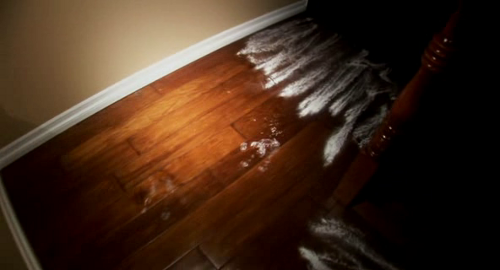
Baby powder on the floor?  Yup, that'll learn 'em.

Having this outlook on the movie, the found footage aspects ultimately benefit Paranormal Activity instead of hindering it.  The hand-held camera is a complete extension of the male's ridiculous need to try and control his environment.  Which is something that from frame one of the film, was never possible and only becomes almost comically more apparent as it goes on.  Micah never once has any real idea what to do about any of this.  He is far too busy goofing around, playing with his gadgets, being condescending to Katie, and trying to convince her that she is dumb and unreasonable and that he is the one who is going to fix everything because nobody fucks with his girl.

Thankfully, (to not make his character a complete, unsympathetic buffoon), there are wonderful moments scattered throughout the movie that demonstrate that Micah's just as vulnerable as Katie is and most likely really does care for her beyond just a cave man need to protect the proposed human that is going to give birth to the fruit of his seed.  When he is not ignoring her, Katie's breakdowns occasionally make him drop the macho facade and realize how seriously distraught she is.  Sadly for both of them, (but not for the demon who is played each of them like a fiddle the whole time), he realizes this far too late.  By the last night, Micah has pretty much given up in frustration.  It is unclear if the weight of not only how ultimately helpless he has been has sunk in, but also if the realization that he is the one who has made their situation the tragic thing that it is has really registered with him.  The latter is most likely, but whether he knows this or was ever going to is left to ponder since well, things of course do not end all that great for him.

Not so great at all.

The theatrical ending to Paranormal Activity was one that was re-shot on the insistence of the producers who naturally wanted to maximize its box office potential.  This ending works well enough and does not reek of what it is thankfully, probably more so to with the fact that the initial one was a bit too long and complicated.  It had Katie sitting in a chair for several days, her sister showing up, cops showing up, a shoot out, and yeah, it rather sounds like at that point it was best to wrap it up while the tension of that last night was at peak level.  I could do without the stupid CGI demon face which is a bit clashing to the rest of how realistically the movie was presented, but at least it only pops up for about half a second.

There was one other moment where Katie Featherston was not pulling off the best improvised dialog during the initial visit with the ghost doctor guy.  These are really the only qualms I can find with the film though.  As far as who edited all of this footage and decided to put titles in the beginning and end, sadly there is no other explanation than the fact that nobody probably trusted that it could have been released in a more naked form.  I will swallow that pill though to enjoy everything else Paranormal Activity has to offer.  It may not be as terrifying as that first time that I saw it and it may have spawned a whole lot of garbage horror movies that took none of the fascinating subtext that came along with it, instead just thinking that shaking a camera around would do the trick, but this is a fair trade.  A fair trade for being able to appreciate the story it really tells as well its technical achievement at being a paramount work in the found footage camp that pretty much shows what can be exceptionally done within the medium.

Now who is going to clean up all that goddamn baby powder?

Friday, October 25, 2019

Marianne - Season One

MARIANNE
Season One
(2019)
Dir - Samuel Bodin
OVERALL: MEH

Arriving just in time to get a proper enough buzz going for it for the Fall/Halloween season, (the ideal period for most cinematic horror properties to get unleashed), Marianne is the latest foreign export to successfully and unabashedly cater to genre fanatics.  This is not a knock on the program right out of the gate by the way.  Yet it would be unmistakable to come to any conclusions that the creative parties involved were not going for the most balls-out horror tinged program they could possibly muster.  The genre is heavily seeped in the program's every pore.

Marianne is one of the eleven series that Netflix debuted this summer and the first French horror one to make a significant impression.  It was co-written and exclusively directed by Samuel Bodin, a television director who also happened to make the bizarre, short fan film Batman: Ashes to Ashes.  Ten years later, he has delivered an ambitious, original work that owes enough to dozens of other sources to stand on its own.  There are certainly things that do not come together in Marianne and its reliance on contemporary tropes is understandable from a commercial perspective, but a lot of the problems present are due to the nature of being a, (so far), single television season.

The way that such programs come into being is that a lone season is greenlit for x-amount of episodes and if all goes well, it will return for more.  Netflix generally has a "wrap-it up in three or four seasons, period" moto which is both good and bad.  It is good in the fact that by giving every property the potential to expand itself yet not take up a decade or so of everyone's time with a new batch of episodes every year, stories can be told much more compactly.  There is little worry about any series overstaying its welcome and prattling on with ultimately pointless episodes that do not further advance any overall arc.  There sure are lots of programs out there to choose from, more than ever in fact so it is a sufficient formula to get in, get out, and get on to the next whatever thing that you are going to watch because we all got shit to do.

I mean, these socks are not going to fold themselves amiright?

The negative aspect of this concept is that sometimes a show does not get picked up again and one batch of episodes is all that you are going to get.  So this presents the people making them with the hugely difficult task of trying to hook enough viewers to get those numbers up there to make more episodes while at the same time trying to make their world seem as vast and detailed as possible.  Marianne is a partial success in this respect.  It tells a point A to point B story in eight episodes and can essentially leave itself hanging where it leaves off, be it somewhat unfortunately.  Still, better to leave em wanting more right?  That said, it also throws in a whole lot of stuff that doesn't pay off in the allowed lifespan it has so far.  Worse yet, other plot points are downright bulldozed over, making room for its own frustrating problems.

Halfway through Marianne, we get a flashback episode that comes awfully close to crashing the entire series into a mountain.  Finally given an answer as to what set all of the unfortunate, spooky events in motion when most of the main characters were teenagers, it is insultingly stupid how Victoire Du Bois' lead character Emma Larsimon decides to become an unrelenting outcast and scumbag doing everything she can to make her parents, friends, and the entire town she lives in disown her just because a single priest who was already a giant asshole to her tells her she has no choice.  Also, the entire unearthing of the title character and how or why exactly she decides to emerge when she does after a few stupid teenagers perform the most generic seance they can is a bit flimsy.

There is a bigger issue in the fact that Marianne makes an all too common problem of giving their supernatural powerhouse completely arbitrary powers.  When the show kicks off, Marianne is currently possessing the mother of Emma's friend who led the initial seance when they were younger, but why now and why bother?  What does writing about her in Emma's books have to do with anything?  She speaks through Emma for a few seconds when originally summoned, but showed up in her dreams before and after that, as well as other peoples dreams.  She can also appear as the younger sister of her friend or pretty much anybody at any time as we later find out, as well as a stuffed animal or pretty much any object as we later find out.  Sometimes she needs to put people's teeth in human skin sacks to keep people from moving, (or something), sometimes her body is in a hole and sometimes it is in an open grave, sometimes a necklace temporarily stops her, sometimes she possesses people so successfully that they are powerless to regain control, sometimes she just casually possesses people, etc.  Basically, this Marianne broad has absolutely no problem doing whatever she wants to whoever she wants at any time unless the script wants to make it seem like she is not doing whatever she wants to whoever she wants for a specific amount of time.

I wonder if anyone in horror movies know that the Ouija board is actually trademarked by Hasbro.  So I guess this counts as product placement?

Now granted, some of this could be expanded upon if Marianne gets a chance to dig deeper into its mythology.  Yet it sure seems an awful, awful lot like the people who made the show simply wanted to put as much cool, horror movie shit in as they could because horror movies are cool and people like cool horror movie shit.  Again, this is because you better hook your audience quick or risk losing them and the network that gave the thumbs up for your series to begin with.  So essentially, the logical part of your brain that asks rather standard questions which the show has no proper opportunity to answer under the circumstances has to be turned off to fully embrace the experience.  Which falls into the very broad, general concept that the horror film, (or TV show), is in many ways broken as far as how the general public is conditioned and often forced to partake of it.

Is there potential to tell a captivating story with Marianne and have its horror movie cake as well?  Yes and no.  Despite eight episodes to play with, the format here does not particularly allow such a thing, at least not when you have to have all of those boo scares, freaky, bug-eyed monster faces, creepy music, muted color pallets, and more boo scares thrown into the mix.  You have to give the people what they want and what they want is the stuff that lets them know that they are watching a horror thing every single step of the way.  I applaud Bodin and his creative team here as well as the cast who are undoubtedly doing their absolute best and convincingly having a very fun time with the material.  You can certainly see where Marianne can excel more at, essentially meaning its story which is incredibly more interesting than the endless stream of visual and audio cliches it keeps pummeling you with.

Since ambiguity is not really allowed and that ship has already sailed, it would be nice to really flesh out the universe here and clean up some of the mess in future seasons.  Getting to the bottom of how Marianne can do the things that she does and why as opposed to just saying "because horror movies, who cares?", would be a very lovely endeavor to sign up for.  Time will have to tell though and if indeed everyone involved is just happy to go all creepy haunted house window dressing for subsequent seasons, it will definitely be enjoyable for many.  One could hold horror up to higher standards, perhaps impossible ones in this case, but it is still nice that people are trying and putting the content out there.  Marianne is by no means a failure and it would be great to enjoy it a lot more.  Maybe we should wait and see if we find out what in the goddamn hell all of those black, muck-covered, reaching hands in her grave in the last episode were all about.

If I had those many hands, I would never leave the house.  I would also probably want to clean them off first though.

Tuesday, October 22, 2019

Anime Horror - Devilman OVAs

DEVILMAN VOL. 1: THE BIRTH
(1987)
Dir - Umanosuke Iida
Overall: MEH

Visually fun with some bonkers creature designs and loads of hilarious profanity and gore, the first in the OVA adaptations of Yasutaka Nagai's novelization of his brother Go Nagai's Devilman manga, Devilman Vol. 1: The Birth is pretty asinine.  The entire concept of having to merge yourself with a demon in order to defeat one is pointless since two humans were rather easily able to stop one with a mere shotgun.  In addition, their grand scheme to turn a whole nightclub full of innocent people into demons, (after murdering several beforehand of course), so they can put themselves in a highly unnecessary predicament where they have to then destroy them once they have all turned is laughably stupid.  Even though it all ends up working out which is actually even more stupid.  Both the plotting and dialog are so appalling that it borders on parody, yet the series has long been beloved either in spite of or because of its silliness.

DEVILMAN VOL. 2: THE DEMON BIRD
(1990)
Dir - Umanosuke Iida
Overall: MEH

Following up the rather stupid Devilman Vol. 1: The Birth is the even more stupid Devilman Vol. 2: The Demon Bird.  Animator/filmmaker Umanosuke Iida returns once again, adapting the initial manga and novel material by Go Nagai and his brother Yasutaka.  While it is a plus that the rather ridiculous origin story is done and out of the way, all that is left is for a three long, boring fight scenes to go by without advancing hardly any type of story whatsoever.  The dialog is even more embarrassingly terrible this time, especially when profanity is used, ("If you ever say that again I'll rip off your fucking head and shit down your neck!", per example).  Likewise, at least the English version has comical line-readings throughout the entire thing so even if the script was not as moronic as it is, it still would come off that way.  Yet for those who find these qualities to be enduring, over the top anime hallmarks, it is jammed pack with enough of them to make for a mind-numbingly goofy experience.

AMON: THE APOCALYPSE OF DEVILMAN
(2000)
Dir - Kenichi Takeshita
Overall: MEH

Breaking away from being a straight adaptation of the Nagai brother's written source material, Amon: The Apocalypse of Devilman more specifically follows the previous OVAs made by Umanosuke Iida.  Arriving thirteen years after the original anime film and changing up the creative team, it is tonally far less absurd, bringing the barely scripted and hyper, ultra-violent nonsense of the first two installments much more down to earth.  The plus side of the trade-off is an actual story with at least some sort of emotional pay-off and still plenty of outrageous, gory battle scenes and inventive demon design elements.  Also, the dialog is sparse, (which is a good move in and of itself), and nowhere near as mortifying.  At a mere forty-four minutes and finally breaking the mold of a weak set-up followed by one uninteresting battle scene after the other, it feels like there is more that could have been explored here.  That said, it still does not necessary feel rushed either as the pacing is too lumbering.  It is a noticeable improvement for sure, but the franchise is still struggling all the same.