Sunday, July 14, 2024

1950s American Horror Part Twenty-One - (Fred F. Sears Edition)

EARTH VS. THE FLYING SAUCERS
(1956)
Overall: MEH
 
Scientist and Military Personnel Standing in Conference Rooms and Laboratories While Talking - The Movie a.k.a. Columbia Pictures' Earth vs. The Flying Saucers, (Invasion of the Flying Saucers, Flying Saucers from Outer Space), is a fittingly generic sci-fi yarn.  To be fair, it is notable for containing Ray Harryhausen's stop-motion animation for alien vessels instead of prehistoric dinosaurs or mythical monsters.  Even though such scenes are punctuated with clumsy stock footage, they are not any less engaging than several other extraterrestrial takeover movie from the period.  The script is based off of Donald Keyhoe's novel Flying Saucers from Outer Space and offers up no moral parables or intellectually challenging ideas though, at least outside of the bare-bones, "humans shoot first and ask questions later" variety.  It is broken up into sixty percent square-jawed white men and one pretty white lady doing a whole lot of talking, forty percent extraterrestrial spacecrafts trying to communicate in funny voices before blowing things up, and all of it is stagnantly paced.  With zero compelling characters and an equally boring series of scenes that have people trying to thwart such an earth-ending dilemma, it is forgettable at best and forgoes the more interesting tropes of the genre while sticking stubbornly to the most dull ones.
 
THE WEREWOLF
(1956)
Overall: MEH

Notable as one of the few American werewolf movies that was produced in the decade dominated by science fiction-tinged horror films, the appropriately titled The Werewolf unfortunately has little to offer fans of the lycanthropian genre.  Steven Ritch's title-character fits the stereotypical tragic mold of an everyman who is doomed due to their newly found predicament, roaming the countryside while begging those who are hapless enough to cross his path to leave him alone lest his bestial fury get unleashed.  That said, there are some wacky details inherent in James B. Gordon and Robert E. Kent's screenplay, with Ritch suffering a car accident and then getting transformed by an experimental wolf serum, administered by doomsday-prepping doctors of course.  Ridiculous stuff, but the absence of gypsies, full moons, silver bullets, and actual wolf bites are unique, with Ritch switching to monster-mode whenever he gets threatened and often times in broad daylight without even disrupting the fabric of his clothing.  The makeup is patchy and mediocre at best, more closely in line with Matt Willis' from 1943's Return of the Vampire than Jack Pierce's legendary work on Lon Chaney Jr. in Universal's The Wolfman.  We only get a couple of minutes of screen time with Ritch wolfed-out anyway, making for a rudimentary, talky, and bland affair.
 
THE GIANT CLAW
(1957)
Overall: MEH
 
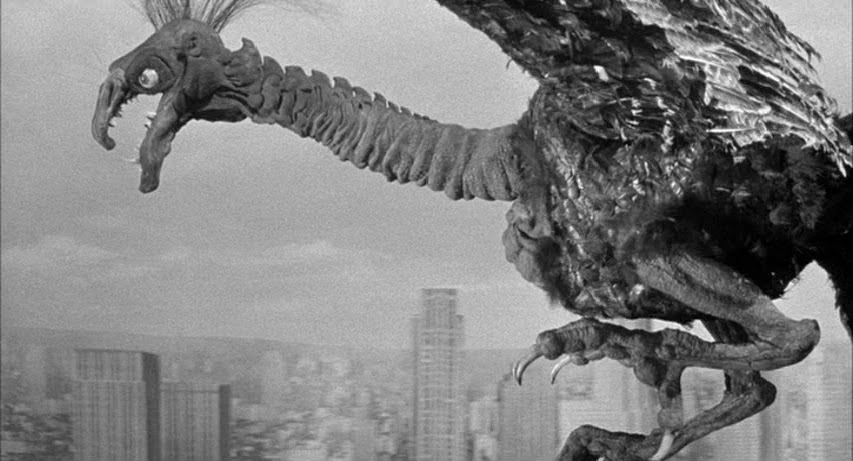
A typically chatty and ergo boring B-movie, The Giant Claw has the added detriment of arguably the worst rendered monster in cinema history, at least from a major production company.  Columbia Pictures allegedly had planned to have Ray Harryhausen provide his reliable stop-motion effects, but instead and regrettably, the bonehead move was made to employ an insufficient Mexican company with the job, a company that turned in a clunky and hilariously stupid puppet.  The schlock director/producer team of Fred F. Sears and Sam Katzman further blundered the proceedings by shooting the antimatter extraterrestrial bird monstrosity exclusively in broad daylight, just to emphasis every nook and cranny of how embarrassing and not-at-all-threatening it looks.  Though such a creature provides endless unintended hysterics, its screen time takes a backseat to the usual crop of scientist and military dead weights having endless debates as to how the monster can be stopped, with both Jeff Morrow and Mara Corday making as bland of a quick-bantered, attractive Caucasian couple as can be.  Flatly directed and formulaic to a fault, (on top of its moronic-looking, giant feathered-fiend), its infamy is well-deserved.
 
THE NIGHT THE WORLD EXPLODED
(1957)
Overall: WOOF

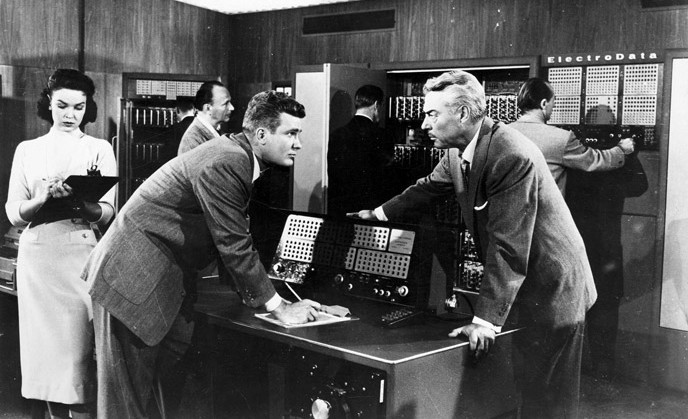
A humdrum disaster cheapie, The Night the World Exploded was one of the last films from director Fred F. Sears to be released before his untimely death at the age of only forty-four.  As one could surmise from the involvement of schlock producer Sam Katzman who seemed to churn out a low-end drive-in double feature every couple of hours during this era, the movie is bare-bones in its efforts.  Delivered on time and on budget, Sears exclusively sticks to the "point the camera at the actors, make sure that they are all in frame, let them deliver their dialog, cut - next scene" method, with the only momentum stemming from how quickly the scientific jibber-jabber can fly out of everyone's mouths.  The two attractive, love-torn white leads have a non-threatening heterosexual chemistry together, the narration makes sure that even a clinically braindead viewer stays on track, there are a couple of throwaway lines about the earth striking back due to mankind draining it of its resources, the stock footage count is through the roof, and everyone talks while standing in rooms for at least sixty-three and a half of the sixty-four minute running time.  Even by such unimaginative standards, this one has nada to offer.

Saturday, July 13, 2024

1950s American Horror Part Twenty - (Richard E. Cunha Edition)

GIANT FROM THE UNKNOWN
(1958)
Overall: WOOF
 
Cinematographer-turned-director Richard E. Cunha only got behind the lens on six features, the first of which was the painfully humdrum Giant from the Unknown, (Giant from Devil's Crag, The Diablo Giant).  Oddly perhaps, the film's downfall is that it is as competently made as any other low-budget, independent drive-in B-movie, meaning no better or worse than the most forgettable of them.  Cunha points his camera at what he is supposed to, the music hardly ever shuts up as was the norm, the Caucasian leads, (including one playing a Native American), all fit the blandly "Aww shucks" bill, and a monster of sorts shows up in the last act.  As far as compelling dialog, interesting characters, clever themes, impressive visual flourishes, or memorable set pieces, there is none of that to be found.  Overtly talky to the point where any sane viewer will turn it off long before six foot six Buddy Baer shows up to stumble around and stare for a couple of seconds, there is a fetching side-note for genre fans at least in that none other than Jack Pierce did Baer's Neanderthal-esque make-up job, even if it is a far cry from his iconic Universal work.
 
SHE DEMONS
(1958)
Overall: MEH
 
A typically sluggish drive-in cheapie, She Demons at least boasts a unique angle for fusing the Nazisploitation, jungle woman, and mad scientist sub-genres together.  Made for around sixty-five thousand dollars as part of a double bill with the same year's Giant from the Unknown, director/co-writer Richard E. Cunha keeps it simple with only three characters, (chisel-jawed Tod Griffin, wise-crackin' Irish McCalla, and Asian American character actor Victor Sen Yung speaking without any stereotypical accent or mannerisms), who do a tremendous amount of talking before they finally come in contact with dancing, scantily-clad tribal ladies and some Nazi refugees who are doing evil experiments because what else would Nazi refugees be doing in such a situation?  The plot line writes itself as one could imagine, but the specific pairing of cliches gives it a slight edge over other such B-movies that isolated their tropes instead of haphazardly slamming desperate ones together, as is the case here.  Even with a meandering pace, pulp sensibilities, and hilariously dated acting, the make-up work on the female demons of the title is wonderfully garish, which along with their gyrating and barely-clothed bodies, gives the film just enough mild sleaze to laugh at.

FRANKENSTEIN'S DAUGHTER
(1958)
Overall: MEH
 
Indistinguishably in line with American International Pictures' crop of teenage monster movies, (which included its own schlocky ode to Marry Shelley with I Was a Teenage Frankenstein), Frankenstein's Daughter is just as forgettable and stupid.  We have cringe-worthy musical numbers, youngsters having a lūʻau, gargantuan amounts of talking, women fainting, women being gaslit by men in nearly every scene, outrageously bad creature make-up, and a moronic, hilariously chauvinistic mad scientist agenda from a Frankenstein relative played with bland abandon by square-jawed Donald Murphy.  Speaking of bland, the world's most uncharastmatic actor John Ashley was top-billed, looks as bored as ever, and gets the brunt of the "not believing any word that his hysterical girlfriend ever says" dialog, though Murphy comes a close second in trying to convince everyone that Sandra Knight imagines all of the things that happens to her.  Notably embarrassing for having a man portray the hulking, re-animated lady brute, all other aspects of the production are neither worth remembering nor discussing.

Friday, July 12, 2024

1940s Jean Yarbrough Horror Part Two

THE BRUTE MAN
(1946)
Overall: WOOF
 
One of the later horror works to be produced by Universal's B-unit until they switched gears to more science fiction movies in the 1950s, The Brute Man also features the final performance from character actor Rondo Hatton who succumbed to his acromegaly affliction eight months before the film's first screening.  Universal actually portioned the movie off to Poverty Row company Producers Releasing Corporation for distribution, further distancing themselves from both a lackluster product and one that took questionable advantage of Hatton's physical deformity which was sensationalized in the actual story.  Serving as a prequel of sorts to House of Horrors which also starred Hatton as "The Creeper" and was released earlier the same year, the results are unmistakably poor and suffer from an action-less script and a sad performance by Hatton who seems confused, in pain, and incapable of emoting throughout.  Even by the shoddy standards that such movies had frequently deteriorated to by the mid 1940s, this one has no redeemable qualities and is as dull as it is uncomfortable to endure.

THE CREEPER
(1948)
Overall: WOOF

It takes a special kind of bad movie to be both stupid and boring and director Jean Yardbrough delivers just such a thing with The Creeper.  A B-movie that is sorely lacking in imagination, it was distributed by Twentieth Century-Fox yet it has all of the hallmarks of Poverty Row genre crud rocks; no star power, no agency to the plot, and hardly any visual flourishes to even cement it as a horror film.  There are a few hazy nightmare-esque sequences and we see a pair of hairy cat hands, but the fun stops there as the entirety of the movie is stagnant melodrama, uninteresting characters and their uninteresting squabbles, and buried underneath all of that, some semblance of another hackneyed mad scientist kind-of story.  The women have it worst of all as poor Janis Wilson spends the whole movie annoying everyone (and the viewer) with her fear of felines and June Vincent just seems unreasonably crotchety towards her would-be love interest.  It mercifully ends at the sixty-four minute mark, but anyone coming to the proceedings with expectations to be "creeped out", (judging by the title), will instead leave both angry and disappointed.

MASTER MINDS
(1949)
Overall: MEH

The sixteenth Bowery Boys movie out of a staggering forty-eight of them and the second one to have a horror angle, Master Minds is notable for featuring Glenn Strange's final performance as a monster in a feature length film.  They still do not let Strange deliver any dialog, at least in his actual voice since his brain is transplanted to Huntz Hall and visa versa, which allows for Hall to dub his dialog so that the six foot, four-inch character actor can nyuck it up more than he was usually allowed.  A typical body-swap romp in this regard, it is a treat for old school monster movie fans to see Strange getting more to do than just hulk around while growling, (though he still does plenty of that as well), plus Alan Napier makes a fine, posh mad scientist and Skeleton Knaggs' gnarly mug is always a nice addition.  As far as the Bowery Boys go, they are not as annoying as other Poverty Row comedy gangs, but they are not as funny as the household name ones from the era either.  Still, they and the film in general have some innocent and doofy charm, plus the script also manages to shoehorn in Hall being granted premonition powers when he gets a tooth ache.

Thursday, July 11, 2024

1940s Jean Yarbrough Horror Part One

KING OF THE ZOMBIES
(1941)
Overall: MEH

Regrettably, an innocent goof fest like King of the Zombies must be looked at as a "what could have been" movie since both Béla Lugosi and Peter Lorre were in line to play the mad island voodoo doctor bad guy who was instead portrayed by character actor Henry Victor at the eleventh hour.  Though Victor does a credible job with a pretentious accent and is a physically more imposing figure than either Lugosi or Lorre, the latter two horror regulars had oodles more macabre charisma at their disposal.  The first half amounts to Mantan Moreland getting gaslit by everyone who never believe that he keeps running into walking corpses in Victor's spacious mansion.  This actually features a hefty amount of screen time for Moreland who single-handedly garnishes the movie's few intentional laughs, but the political incorrectness is as steadfast as ever.  As soon as he arrives on the mysterious island, he is not only ordered to sleep in the kitchen with the other non-white servants, but also put to work washing dishes since what else was a rich white guy like Victor supposed to allow a black man to do besides chores in a house that he does not even work in?

HOUSE OF HORRORS
(1946)
Overall: MEH

Universal sure liked to use the word "House" in their titles and the penultimate screen appearance of Rondo Hatton as "The Creeper" is in the misleadingly titled House of Horrors, yet another run of the mill B-picture for the studio.  Both this and the same year's The Brute Man share the writer/director team of George Bricker and Jean Yarbrough, though each is a stand-alone entry with Hatton simply playing two versions of the same character.  The story here revolves around uppity art critics, (one of whom is played in a deliciously pompous fashion by future Alfred Pennyworth Alien Napier), getting murdered by Hatton's neanderthal-like killer on the run.  The latter forms an alliance with a starving sculptor played by German actor Martin Kosleck who is basically a less charismatic Peter Lorre.  None of the other cast members are notable; just a stable of good looking men and women trading niceties with each other.  Also, nothing remotely frightening takes place at any time and the "horror" element solely revolves around Hatton's startling acromegaly-induced features.  Still, Yarbrough keeps up a fine pace for the rudimentary and borderline monotonous plot.
 
SHE-WOLF OF LONDON
(1946)
Overall: MEH

If not for the fact that it is acted and directed in a competent manner, has some nice foggy scenery, and is done and over with in a mere sixty-one minutes, Universal's She-Wolf of London would be a top-to-bottom dud.  It is still probably the lamest film that the studio ever produced under its "classic monster" umbrella, largely because it wholeheartedly does not belong there.  The title is dishonest at best and the ending is certainly shocking alright, but in the most disappointing way imaginable.  By the time that the film's villain randomly explains their cockamamie scheme, any possible tension that was built up evaporates into the ether and a fully-formed feeling of wasting one's time sets in.  That we do not even get a single glimpse of any lycanthropian activities throughout is aggravating enough as it would have been delightful if Universal's mainstay make-up artist Jack Pierce had been allowed to come up with something ghastly for a female to wear for once.  Instead, this is just a cheap yawn and a missed opportunity.

Wednesday, July 10, 2024

1940s Cheela, the Ape Woman Series

CAPTIVE WILD WOMAN
(1943)
Dir - Edward Dmytryk
Overall: MEH
 
Universal's first of three Cheela, the Ape Woman movies, Captive Wild Woman is the one with John Carradine playing a mad scientist.  Two years in production before it was finally shot, the story had five credited hands involved, which is impressive since the whole thing results to nothing more than a cockamamie tale about sex hormones and brain transplants turning a gorilla into Native American actor Acquanetta.  Though she had some bit parts before this, Universal promoted it as Acquanetta's debut and she fulfills the exotic beauty angle effortlessly even if she does not show up until halfway through and hardly gets anything to do besides not talk and undergo a bestial make-up change.  Carradine is the sinister presence here who seems to delight in coming up with excuses to kill people in the name of science or whatever, which is a hackneyed "ends justifying the means" trope that had already been overused by this point.  Plenty of circus stock footage of lions and tigers in captivity is utilized that has hardly aged well, but the film has a tacky charm to it despite being humdrum in most respects.

JUNGLE WOMAN
(1944)
Dir -Reginald LeBorg
Overall: MEH
 
Following up the previous year's Captive Wild Woman with actor Acquanetta still on board as the same character, Jungle Woman has a rotten reputation as one of Universal's worst horror films from its Golden Era.  While this may seem harsh, such a judgement is not without merit and sadly the top contenders for the studio's weakest works in the genre were often female centered, (She-Wolf of London and The Invisible Woman also come to mind).  The first act is nothing more than a series of flashbacks to footage from the previous film as characters are investigated under oath to bring us up to date.  An opening silhouetted murder sequence is well-done, but this is also repeated again in the finale and even at an hour in length, a significant portion of it proves redundant.  Both star Acquanetta and director Reginald LeBorg voiced their displeasure with the project, which was done for contractual purposes of course.  Acquanetta felt typecast and exploited in a thankless role that hardly required her to do anything, (least of all actually turn into a monster for more than a few seconds), and LeBorg hated the script which in all fairness is no more or less preposterous than any other pseudoscience, B-movie gobbledygook.  J. Carrol Naish saves face in the lead and does not play a bad guy for once, but this is otherwise worth skipping.

JUNGLE CAPTIVE
(1945)
Dir - Harold Young
Overall: MEH

With Acquanetta moving on, Vicky Lane steps in to play the titular Ape Woman in Jungle Captive; the last in Universal's Cheela, the Ape Woman series.  Though it is comparatively superior to its sequel Jungle Woman by boasting a fresh crop of characters and not relying on any recycled footage, it still goes through the stock motions of a mad scientist who justifies his murderous experiments in the same way that all mad scientists do, namely that a few lives are a small price to pay for advancement.  Otto Kruger plays such a misguided villain professionally enough and he is joined by Universal's "Creeper" Rondo Hatton who turns in one of his better performances, even if the poor guy is hired yet again solely due to his alarming and intimidating looks.  Director Harold Young keeps the predictable material from becoming as tiresome as it deserves to be and there are some ghastly bits like grave robbing and Amelita Ward being lured to her doom by her trusted employee, only to get tied down to have her blood removed before a thwarted brain surgery attempt is made on her.  Lane gets to run around in the grisly primate make-up more than Acquanetta ever did as well, but her lack of dialog and personality still makes it a thankless role that any actor could have handled for a paycheck.

Tuesday, July 9, 2024

1940s American Horror Part Sixteen

REVENGE OF THE ZOMBIES
(1943)
Dir - Steve Sekely
Overall: MEH

As much of a remake to Monogram Pictures' 1941 comedy/horror cheapie King of the Zombies as it is a sequel, Revenge of the Zombies sees comic relief character actor Mantan Moreland reprising his role and John Carradine joining the party as the mad scientist.  Madame Sul-Te-Wan also returns as a housekeeper instead of a cook, (not that anyone could decipher the difference), and the screenplay was co-written by Edmond Kelso again, which would explain why it follows the same outline of two white guys and one black guy getting held-up at a creepy castle where voodoo zombie experiments are taking place.  Unfortunately, this is a more stuffy and less amusing excursion than its predecessor.  Moreland has little to do and disappears entirely for long portions, plus the rest of the cast deliver lifeless performances with such equally humdrum material.  Even Carradine fails to grab the bull by the horns and chew any scenery as the Nazi scientist who forgets that he is supposed to have a German accent.  In fact he only shows any emotion whatsoever twice and one of these moments is during his grisly death at the hands of his undead wife.
 
ARSENIC AND OLD LACE
(1944)
Dir - Frank Capra
Overall: GREAT
 
A macabre screwball comedy that by all logic should have had Boris Karloff starring in a role that was tailor-made for him, Arsenic and Old Lace is director Frank Capra's delightful adaptation of Joseph Kesselring 1941 stage play of the same name.  Snagging some of the cast from the theater production as well as replacing others, (including Raymond Massey for Karloff and Peter Lorre as his wimpish and unwilling plastic surgeon side-kick), it is one of several top tier goof-fests to feature Cary Grant in the lead who plays a variation of his Bringing Up Baby character; namely a well-meaning guy that becomes increasingly flummoxed by a plot that only grows more and more ridiculous.  Capra maintains a cruising pace where one outrageous detail gets thrown on top of the other, sometimes with previous arcs getting resolved, but usually with all of them yelling at each other for screen time.  It is often difficult to keep up, which is exactly the type of frustration that Grant portrays as both of his aunts admit to nonchalantly poisoning people as a form of mercy killing, his brand new wife cannot understand why he wants her to leave, a cop dictates a play that he wrote while Grant is left tied to a chair, and his escaped sadistic brother returns with a face that "looks like Boris Karloff".
 
THE CRIMSON GHOST
(1946)
Dir - Fred C. Brannon/William Witney
Overall: MEH

Originally shown as a twelve-part serial in 1946, Republic Pictures' The Crimson Ghost, (Cyclotrode "X"), was later broadcast on television in a re-edited form a few years later and then again as a feature-length film in 1966.  Mostly famous for the look of its title criminal mastermind whose ghoulish mug was utilized by The Misfits as their logo, the story has the usual goofy trajectory of a cockamamie villainous scheme that is punctuated by random fist fights and car crashes until the bad guy is finally apprehended.  For this particular series, you could make a dangerous drinking game out of how many times that characters try and solve their problems by punching them, especially in its condensed form that takes out most of the boring talking bits yet keeps all of the boring action ones, throwing them at the screen in rapid succession of each other.  While this makes for a hilarious watch in some respects, the story is repetitive pulp nonsense and the characters are so bland that only the Crimson Ghost stands out amongst them.  This was the last serial from prolific director William Witney who almost exclusively stuck with Westerns throughout the next four decades of his career.  He and Fred C. Brannon do their best with the silly material and make sure that everyone launches and flips across rooms while duking it out, but it still amounts to a dull watch.

Monday, July 8, 2024

1940s American Horror Part Fifteen - (Sam Newfield Edition)

THE MAD MONSTER
(1942)
Overall: MEH
 
Director Sam Newfield was one of the busiest during Hollywood's Golden Era, using a slew of pseudonyms for various production studios in his three decade long career.  He largely worked in the Western genre, (which includes the infamous The Terror of Tiny Town from 1938), with few horror entries on his resume.  The Mad Monster is an exception, features Glenn Strange as a dim-witted man who gets turned into a werewolf due to a serum concocted by George Zucco's megalomaniacal mad scientist, the latter of whom chews the scenery even more than his bestial creation does.  Strange turns in a Lon Chaney Jr.-esque performance; a gentle giant who becomes ferocious through means that are neither his fault nor under his control.  He also gets plenty of dialog, which is something that Universal never bothered trusting him with for his three Frankenstein monster portrayals.  There is not much to the story, (crazy asshole doctor guy wants to make beastmen to get revenge and take over the world, the end), the pacing drags, and Strange and Zucco are the only thespians on screen who try and elevate the cheap proceedings.
 
DEAD MEN WALK
(1943)
Overall: MEH
 
Featuring one of the last appearances from Dwight Frye and released the same year that he died of a spontaneous heart attack, Dead Men Walk also serves as a rare vampire vehicle for George Zucco who gets a double roll as identical brothers, one a noble doctor and one a diabolical fiend.  As was common with director Sam Newfield's horror works for Poverty Row studio Producers Releasing Corporation, (PRC), the film suffers due to its low production values and merely competent presentation.  Newfield's direction is flat, Jack Greenhalgh's cinematography is bare-bones and lacking in proper atmospherics, and the pacing lulls as Fred Myton's script goes through a series of cliches that offer nothing unique to the undead mythos.  While it is always nice to see Frye on screen busting out the lunacy, his role here just comes off as another Renfield variation, calling Zucco his blood-sucking "master" and playing lackey to him in his small handful of scenes.  On that note, even the top-billed Zucco comes off as bland, spouting threatening dialog in his vampiric form that seems like it was cherry picked from better movies.  He also makes a dull protagonist as the good sibling in what is otherwise an already dull film.
 
THE MONSTER MAKER
(1944)
Overall: MEH

Scoring both J. Carrol Nash and Glenn Strange who also appeared together in Universal's comparatively more prestige House of Frankenstein from the same year, The Monster Maker is a Poverty Row cheapie from Producers Releasing Corporation.  While the premise is ghastly enough with Nash's brilliant acromegaly specialist deliberately inflicting a famous pianist in order to force him into marrying off his daughter, director Sam Newfield seems incapable of making the material either thrill or chill.  Once the plot gets fiendishly underway, the pacing loses any sense of urgency and it just becomes a series of tedious and repetitive scenes.  Strange has a minuscule role as Nash's muscle butter and as he did in The Mad Monster from two years previously, (also directed by Newfield), he actually gets a few lines of dialog, plus the script even manages to shoehorn in a gorilla because what well-respecting mad scientist in a 1940s horror movie can go without one of those?  There is no atmosphere, no humor, and the only monstrous aspects come in form of Ralph Morgan wearing some unflatteringly bulbous make-up, but he does little besides isolate himself in his house and thrash around in a hospital bed anyway.

THE FLYING SERPENT
(1946)
Overall: WOOF

Another collaboration between director Sam Newfield and actor George Zucco for Producers Releasing Corporation, The Flying Serpent, (Killer with Wings), is a nature horror monster movie that manages to work in Aztec folklore and the famed Montezuma treasure legend.  In this universe, the Quetzalcoatl reptile/bird hybrid of the title guards said treasure and Zucco's unhinged archeologist has captured it, sticking it on anyone who upsets him in typical bad guy fashion.  Zucco delivers expository dialog to himself and hams it up accordingly, plus the Quetzalcoatl makes a lackluster impression.  It is neither imposingly large nor convincing, instead being about the size of a hand puppet and getting tossed at people via a wire.  John T. Neville's screenplay bares similarities to his own for the Béla Lugosi vehicle and PRC's initial horror film The Devil Bat, but that one was also subpar and Zucco is no Lugosi.  In effect, this is a mediocre retread of an already mediocre movie and it makes the same Poverty Row missteps of being overtly talky, predictable, and directed with no sense of style or agency by Newfield; a man who was too busy being behind the lens on and cranking out thirteen other movies in 1946 alone.