Wednesday, July 17, 2024

1950s American Horror Part Twenty-Four

ROBOT MONSTER
(1953)
Dir - Phil Tucker
Overall: WOOF
 
A rightfully infamous, Z-grade crud rock, Robot Monster, (Monsters from Mars), is that one movie where the alien is a guy in a gorilla suit with an astronaut helmet on who pronounces "humans" as "hew-mans".  Made in four days for an estimated $16,000 that may as well be seventeen cents, it liberally, obviously, and pointlessly recycles footage from One Million B.C., Lost Continent, Flight to Mars, Rocketship XM, and Captive Woman.  It also has your standard amount of stupid little kids, terrible acting, head-scratching scenes, a mentally ill plot, and comatose-inducing direction from Phil Tucker.  Tucker's only previous work behind the lens was on the crime film Dance Hall Racket, (which was written and starred Lenny Bruce), and he allegedly attempted suicide after this one's release due to financial woes caused by a clash with its distributor.  Not to make light of such a thing, but after watching such incompetent, nonsensical, and, (above all else), boring tripe, it is no wonder that the man who put his name on it was in a severely depressed state afterwards.  As a bad movie watch, it has its moments of unintentional ineptitude and it is impossible not to laugh at every one of the extraterrestrial primate Ro-Man's ridiculous arm-waving appearances, but otherwise, the whole thing is more dull than stupid.  Though make no mistake, stupid it surely is.

THE HIDEOUS SUN DEMON
(1958)
Dir -Tom Boutross/Robert Clarke
Overall: MEH

The only directorial effort from Tom Boutross and actor Robert Clarke, (the latter of whom also co-wrote, produced and starred in the lead here), The Hideous Sun Demon, (Sun Demon, Blood on His Lips), is a low-grade monster cheapie with one or two redeemable qualities.  Shot over the course of twelve weekends, it is an admirable labor of love in some respects, making the best use out of its insufficient budget with locations in place of actual sets, a stock musical score that many will recognize was also utilized in George A. Romero's Night of the Living Dead, a Jekyll & Hyde/werewolf-adjacent story that is inconsistent with its rules yet rudimentary to follow, and a beastly makeup design that is better than most rubber suit creatures from the era; still cheap looking yet garish in its reptilian ugliness.  Not that it makes nearly enough appearances since the movie is forced to concern itself with badly recorded dialog exchanges between a cast made up of film students and non-actor family members and friends of Clarke's.  This is ultimately the movie's downfall since it is inescapably dull within its meager means, plus Clark and Boutross' direction is as lifeless as the performances are.
 
THE KILLER SHREWS
(1959)
Dir - Ray Kellogg
Overall: MEH

Shot back-to-back with The Giant Gila Monster, The Killer Shrews is a regional creature feature that has aged about as bad as any others of its kind, though it is not without some some low-grade charm.  Visual effects man-turned director Ray Kellogg works within a pocket change budget, throwing his characters in a tiny house on an island whose only protection is a wood fence that stretches plausibility in keeping out the upwards of two-hundred, (or so we are told), oversized varmints of the title.  Speaking of verisimilitude being shortchanged, the shrews themselves are adorable hand puppets in the closeups and sparely covered coonhounds in the wide shots, but to Kellogg's credit, he tries to mitigate their on-screen appearances and keeps the editing sharp enough to hide how ridiculous they look.  Plot wise, this is a variation of the framework that George A. Romero would utilize nine years later in Night of the Living Dead, where a small handful of people are held up in an abode while monster things try to get at them and one of the humans is an asshole who cannot be trusted, but this was before unhappy endings became the norm so most of them make it out through an inventive steel chemical drum gag.  It is still silly stuff with too much yakety-yaking between uninteresting characters, but it takes itself seriously enough to deliver some unintended chuckles.

Tuesday, July 16, 2024

1950s American Horror Part Twenty-Three

THE UNEARTHLY
(1957)
Dir - Boris Petroff
Overall: MEH
 
The only horror work from low-budget director/producer Boris Petroff, The Unearthly is typical potboiler stuff, churned out with little enthusiasm to unceremoniously fill another double-bill slot for drive-ins.  Shot in five days and with insufficient funds, this was the second to last feature that production designer Charles D. Hall was involved with, who had previously worked on various seminal genre films for Universal.  His work here is as pedestrian as everyone else's involved though, through no fault of their own.  Still, B-movie aficionados may be pleased to see John Carradine, Tor Johnson, and scream queen Allison Hayes all under the same roof.  Carradine's mad scientist scheme is as asinine as any, (something about artificially creating a new gland to make people immortal), and Johnson gets to do his usual shtick of stumbling around as a hulking brute, but he actually gets one or two dim-witted lines of dialog this time for what it is worth.  The melodrama is laid on thick and ridiculously, the special effects and make-up are crude, the plot is as predictable as they come, and Carradine gets to chew plenty of scenery at his leisure, so the whole thing is not without its goofy perks.

DEVIL'S PARTNER
(1958)
Dir - Charles R. Rondeau
Overall: MEH
 
An early full-length from prolific television director Charles R. Rondeau, Devil's Partner is both poorly directed and staged, but it has some unsettling atmospherics that most D-rent production studios rarely delivered.  Accounts vary as far as when it was officially released, (ranging from anywhere between 1958 and 1961), with Roger and Gene Corman's Filmgroup at one point putting it out on a double bill with the former's Creature from the Haunted Sea.  In any event, it has some macabre moments which involve live animal sacrifices whose blood is decorated over a hexagon on the floor and though the camera turns away from overtly showing the ghastly details, they still provide a startling image for the era's drive-in crowds.  As far as the story goes, it is a strange one which involves an old man and his alleged nephew conducting demonic rituals against various townsfolk for flimsy reasons, but the majority of the plot is full of generic actors giving stiff performances as uninteresting characters.  Overly chatty and badly paced, both Rondeau and Edward Cronjager's shot construction is as bare-bones as it comes and the whole thing builds to a yawn-inducing conclusion.
 
THE MONSTER OF PIEDRAS BLANCAS
(1959)
Dir - Irvin Berwick
Overall: WOOF
 
The directorial debut from uncredited dialog coach Irvin Berwick, The Monster of Piedras Blancas is easily on the shortlist of bottom-barrel Creature from the Black Lagoon knock-offs.  In fact both Berwick and producer Jack Kevan had each done odds and ends at Universal and Columbia Pictures before forming their own small-scale production company Vanwick Productions, which only made this and one other feature seven years later.  This is probably for the best since either a lack of talent or a lack of funds, (or both), play a detrimental role in the final product which is staggeringly boring from top-to-bottom.  The costume for the monster of the title was allegedly pieced together from preexisting molds from The Mole People and This Island Earth, but the thing does not fully show up on screen until the last eight minutes.  Before that, we only get a hilariously awkward instruction to the creature by only seeing his bottom half carrying a severed head, which by all accounts is more "gory" than many other films from the era were allowed to be.  Said head shows up later with a live crab crawling over it, but these are the only two other moments besides the unceremonious finale that provide anything besides library-cued music playing arbitrarily through every scene and insultingly uninteresting characters just talking yawn-inducing nonsense with each other.

Monday, July 15, 2024

1950s American Horror Part Twenty-Two

THE UNKNOWN TERROR
(1957)
Dir - Charles Marquis Warren
Overall: WOOF
 
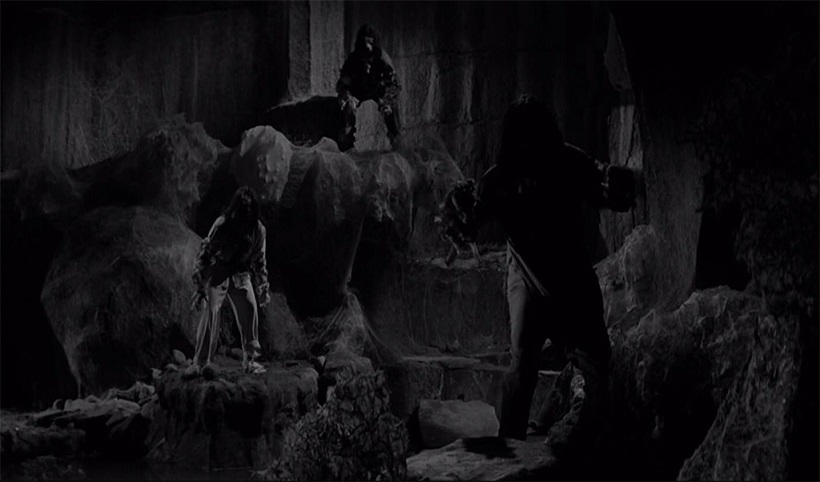
Primitive natives and uncharasmatic white people join forces again in The Unknown Terror; a B-level crud rock with only a couple of minutes in the last set piece to provide some unintentional chuckles for any audience member that is still awake while watching.  The first of eight quickly made cheapies by 20th Century Fox and director Charles Marquis Warren's Emirau Productions, it brings back calypso singer Sir Lancelot after nearly a decade-long break from feature film appearances.  Lancelot does his I Walked with a Zombie shtick of singing a ukulele ditty, (with lyrics that tie-in to the story), to whoever recently arrives on foreign soil, in this case being a couple of people looking for a relative that went missing during an exploration of the dreaded "Cave of the Dead".  Said cave ends up being nothing more than dingy-lit set that the special effects team pours detergent bubbles over, which because movies are silly, creates human fungi monsters with bulbous cotton balls glued to their faces.  Not that we get any clear shots of them, (wisely so), or much screen time of such a threat, as almost the entire thing is just another excuse to have boring characters exchange boring dialog while the boring, library-cued music never shuts the hell up.
 
TEENAGE MONSTER 
(1958)
Dir - Jacques R. Marquette
Overall: WOOF

With a title like Teenage Monster, (Meteor Monster), and having been released in 1958, one would assume that this belongs in with the slew of drive-in genre films from the era that featured and were catered to contemporary teenager antics like school, convertibles, chicks, and rock music.  Such is not the case though since this is oddly a western/horror hybrid centered around a blackmailing companion and a "teenage" simpleton who is portrayed by a fifty-year old Gilbert Perkins, looking every bit of his age even under Jack Pierce's hairy caveman makeup.  Perkins spends the entirely of the film pathetically moaning his unintelligible dialog while his mother, (Anne Gwynne), scolds him for killing people, makes him promise to stop killing people, and then leaves him alone so that he can nonchalantly go kill people again.  The only directorial effort from cinematographer/producer Jacques R. Marquette, the movie was whipped together quickly and for as little money as possible to fulfill a double bill with The Brain from Planet Arous and the production easily reeks of such uninspired dinginess.

THE MANSTER
(1959)
Dir - George P. Breakston/Kenneth G. Crane
Overall: MEH
 
An anomaly of sorts since it was an American production that was made in Japan and with various local actors speaking English, (some barely if at all with an accent even), The Manster, (Sōtō no Satsujinki, The Split), is otherwise unintentionally funny, potboiler tripe.  The typical mad scientist angle is taken where someone is working on a serum or a whatever because also whatever, only for it to of course go horrendously awry even after every previous attempt has also gone awry, which one would think would not be the least bit surprising for said mad scientist, (here played with zero enthusiasm by Tetsu Nakamura).  As the doomed victim/eventual manster of the title, Peter Dyneley first starts acting like an asshole before literally a new creature grows out of him in the form of a hilarious puppet head attached to his shoulder.  The makeup and visual effects are primitive at best, but they also have a horrifically gaudy charm to them that serves its alarming purpose just fine for such a low-rent production.  It lumbers along plot wise, taking forever for Dynelely to start transforming and going on murderous rampages, so we instead get to witness him gallivanting around Tokyo as a womanizing scumbag for the first two acts.  There are a couple of jarring moments to point and laugh at, but otherwise this is an international co-production creature feature that is best left forgotten.

Sunday, July 14, 2024

1950s American Horror Part Twenty-One - (Fred F. Sears Edition)

EARTH VS. THE FLYING SAUCERS
(1956)
Overall: MEH
 
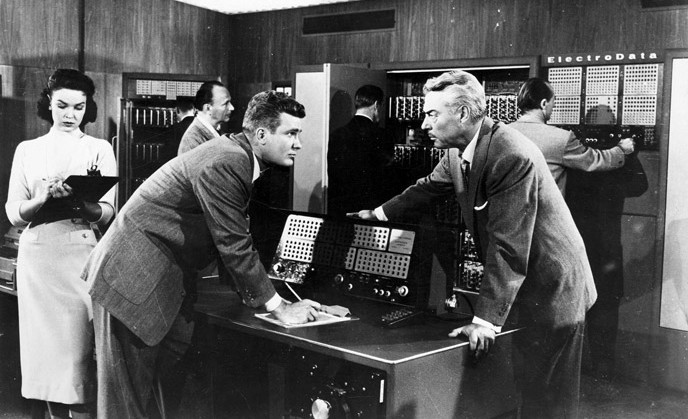
Scientist and Military Personnel Standing in Conference Rooms and Laboratories While Talking - The Movie a.k.a. Columbia Pictures' Earth vs. The Flying Saucers, (Invasion of the Flying Saucers, Flying Saucers from Outer Space), is a fittingly generic sci-fi yarn.  To be fair, it is notable for containing Ray Harryhausen's stop-motion animation for alien vessels instead of prehistoric dinosaurs or mythical monsters.  Even though such scenes are punctuated with clumsy stock footage, they are not any less engaging than several other extraterrestrial takeover movie from the period.  The script is based off of Donald Keyhoe's novel Flying Saucers from Outer Space and offers up no moral parables or intellectually challenging ideas though, at least outside of the bare-bones, "humans shoot first and ask questions later" variety.  It is broken up into sixty percent square-jawed white men and one pretty white lady doing a whole lot of talking, forty percent extraterrestrial spacecrafts trying to communicate in funny voices before blowing things up, and all of it is stagnantly paced.  With zero compelling characters and an equally boring series of scenes that have people trying to thwart such an earth-ending dilemma, it is forgettable at best and forgoes the more interesting tropes of the genre while sticking stubbornly to the most dull ones.
 
THE WEREWOLF
(1956)
Overall: MEH

Notable as one of the few American werewolf movies that was produced in the decade dominated by science fiction-tinged horror films, the appropriately titled The Werewolf unfortunately has little to offer fans of the lycanthropian genre.  Steven Ritch's title-character fits the stereotypical tragic mold of an everyman who is doomed due to their newly found predicament, roaming the countryside while begging those who are hapless enough to cross his path to leave him alone lest his bestial fury get unleashed.  That said, there are some wacky details inherent in James B. Gordon and Robert E. Kent's screenplay, with Ritch suffering a car accident and then getting transformed by an experimental wolf serum, administered by doomsday-prepping doctors of course.  Ridiculous stuff, but the absence of gypsies, full moons, silver bullets, and actual wolf bites are unique, with Ritch switching to monster-mode whenever he gets threatened and often times in broad daylight without even disrupting the fabric of his clothing.  The makeup is patchy and mediocre at best, more closely in line with Matt Willis' from 1943's Return of the Vampire than Jack Pierce's legendary work on Lon Chaney Jr. in Universal's The Wolfman.  We only get a couple of minutes of screen time with Ritch wolfed-out anyway, making for a rudimentary, talky, and bland affair.
 
THE GIANT CLAW
(1957)
Overall: MEH
 
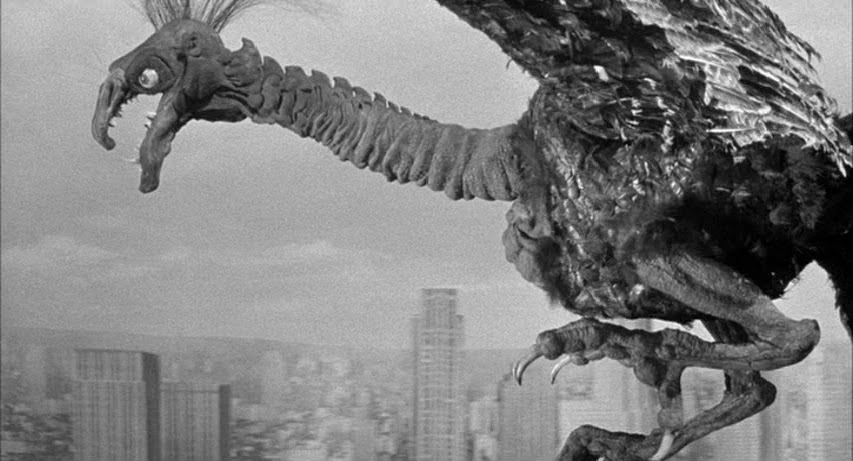
A typically chatty and ergo boring B-movie, The Giant Claw has the added detriment of arguably the worst rendered monster in cinema history, at least from a major production company.  Columbia Pictures allegedly had planned to have Ray Harryhausen provide his reliable stop-motion effects, but instead and regrettably, the bonehead move was made to employ an insufficient Mexican company with the job, a company that turned in a clunky and hilariously stupid puppet.  The schlock director/producer team of Fred F. Sears and Sam Katzman further blundered the proceedings by shooting the antimatter extraterrestrial bird monstrosity exclusively in broad daylight, just to emphasis every nook and cranny of how embarrassing and not-at-all-threatening it looks.  Though such a creature provides endless unintended hysterics, its screen time takes a backseat to the usual crop of scientist and military dead weights having endless debates as to how the monster can be stopped, with both Jeff Morrow and Mara Corday making as bland of a quick-bantered, attractive Caucasian couple as can be.  Flatly directed and formulaic to a fault, (on top of its moronic-looking, giant feathered-fiend), its infamy is well-deserved.
 
THE NIGHT THE WORLD EXPLODED
(1957)
Overall: WOOF

A humdrum disaster cheapie, The Night the World Exploded was one of the last films from director Fred F. Sears to be released before his untimely death at the age of only forty-four.  As one could surmise from the involvement of schlock producer Sam Katzman who seemed to churn out a low-end drive-in double feature every couple of hours during this era, the movie is bare-bones in its efforts.  Delivered on time and on budget, Sears exclusively sticks to the "point the camera at the actors, make sure that they are all in frame, let them deliver their dialog, cut - next scene" method, with the only momentum stemming from how quickly the scientific jibber-jabber can fly out of everyone's mouths.  The two attractive, love-torn white leads have a non-threatening heterosexual chemistry together, the narration makes sure that even a clinically braindead viewer stays on track, there are a couple of throwaway lines about the earth striking back due to mankind draining it of its resources, the stock footage count is through the roof, and everyone talks while standing in rooms for at least sixty-three and a half of the sixty-four minute running time.  Even by such unimaginative standards, this one has nada to offer.

Saturday, July 13, 2024

1950s American Horror Part Twenty - (Richard E. Cunha Edition)

GIANT FROM THE UNKNOWN
(1958)
Overall: WOOF
 
Cinematographer-turned-director Richard E. Cunha only got behind the lens on six features, the first of which was the painfully humdrum Giant from the Unknown, (Giant from Devil's Crag, The Diablo Giant).  Oddly perhaps, the film's downfall is that it is as competently made as any other low-budget, independent drive-in B-movie, meaning no better or worse than the most forgettable of them.  Cunha points his camera at what he is supposed to, the music hardly ever shuts up as was the norm, the Caucasian leads, (including one playing a Native American), all fit the blandly "Aww shucks" bill, and a monster of sorts shows up in the last act.  As far as compelling dialog, interesting characters, clever themes, impressive visual flourishes, or memorable set pieces, there is none of that to be found.  Overtly talky to the point where any sane viewer will turn it off long before six foot six Buddy Baer shows up to stumble around and stare for a couple of seconds, there is a fetching side-note for genre fans at least in that none other than Jack Pierce did Baer's Neanderthal-esque make-up job, even if it is a far cry from his iconic Universal work.
 
SHE DEMONS
(1958)
Overall: MEH
 
A typically sluggish drive-in cheapie, She Demons at least boasts a unique angle for fusing the Nazisploitation, jungle woman, and mad scientist sub-genres together.  Made for around sixty-five thousand dollars as part of a double bill with the same year's Giant from the Unknown, director/co-writer Richard E. Cunha keeps it simple with only three characters, (chisel-jawed Tod Griffin, wise-crackin' Irish McCalla, and Asian American character actor Victor Sen Yung speaking without any stereotypical accent or mannerisms), who do a tremendous amount of talking before they finally come in contact with dancing, scantily-clad tribal ladies and some Nazi refugees who are doing evil experiments because what else would Nazi refugees be doing in such a situation?  The plot line writes itself as one could imagine, but the specific pairing of cliches gives it a slight edge over other such B-movies that isolated their tropes instead of haphazardly slamming desperate ones together, as is the case here.  Even with a meandering pace, pulp sensibilities, and hilariously dated acting, the make-up work on the female demons of the title is wonderfully garish, which along with their gyrating and barely-clothed bodies, gives the film just enough mild sleaze to laugh at.

FRANKENSTEIN'S DAUGHTER
(1958)
Overall: MEH
 
Indistinguishably in line with American International Pictures' crop of teenage monster movies, (which included its own schlocky ode to Marry Shelley with I Was a Teenage Frankenstein), Frankenstein's Daughter is just as forgettable and stupid.  We have cringe-worthy musical numbers, youngsters having a lūʻau, gargantuan amounts of talking, women fainting, women being gaslit by men in nearly every scene, outrageously bad creature make-up, and a moronic, hilariously chauvinistic mad scientist agenda from a Frankenstein relative played with bland abandon by square-jawed Donald Murphy.  Speaking of bland, the world's most uncharastmatic actor John Ashley was top-billed, looks as bored as ever, and gets the brunt of the "not believing any word that his hysterical girlfriend ever says" dialog, though Murphy comes a close second in trying to convince everyone that Sandra Knight imagines all of the things that happens to her.  Notably embarrassing for having a man portray the hulking, re-animated lady brute, all other aspects of the production are neither worth remembering nor discussing.

Friday, July 12, 2024

1940s Jean Yarbrough Horror Part Two

THE BRUTE MAN
(1946)
Overall: WOOF
 
One of the later horror works to be produced by Universal's B-unit until they switched gears to more science fiction movies in the 1950s, The Brute Man also features the final performance from character actor Rondo Hatton who succumbed to his acromegaly affliction eight months before the film's first screening.  Universal actually portioned the movie off to Poverty Row company Producers Releasing Corporation for distribution, further distancing themselves from both a lackluster product and one that took questionable advantage of Hatton's physical deformity which was sensationalized in the actual story.  Serving as a prequel of sorts to House of Horrors which also starred Hatton as "The Creeper" and was released earlier the same year, the results are unmistakably poor and suffer from an action-less script and a sad performance by Hatton who seems confused, in pain, and incapable of emoting throughout.  Even by the shoddy standards that such movies had frequently deteriorated to by the mid 1940s, this one has no redeemable qualities and is as dull as it is uncomfortable to endure.

THE CREEPER
(1948)
Overall: WOOF

It takes a special kind of bad movie to be both stupid and boring and director Jean Yardbrough delivers just such a thing with The Creeper.  A B-movie that is sorely lacking in imagination, it was distributed by Twentieth Century-Fox yet it has all of the hallmarks of Poverty Row genre crud rocks; no star power, no agency to the plot, and hardly any visual flourishes to even cement it as a horror film.  There are a few hazy nightmare-esque sequences and we see a pair of hairy cat hands, but the fun stops there as the entirety of the movie is stagnant melodrama, uninteresting characters and their uninteresting squabbles, and buried underneath all of that, some semblance of another hackneyed mad scientist kind-of story.  The women have it worst of all as poor Janis Wilson spends the whole movie annoying everyone (and the viewer) with her fear of felines and June Vincent just seems unreasonably crotchety towards her would-be love interest.  It mercifully ends at the sixty-four minute mark, but anyone coming to the proceedings with expectations to be "creeped out", (judging by the title), will instead leave both angry and disappointed.

MASTER MINDS
(1949)
Overall: MEH

The sixteenth Bowery Boys movie out of a staggering forty-eight of them and the second one to have a horror angle, Master Minds is notable for featuring Glenn Strange's final performance as a monster in a feature length film.  They still do not let Strange deliver any dialog, at least in his actual voice since his brain is transplanted to Huntz Hall and visa versa, which allows for Hall to dub his dialog so that the six foot, four-inch character actor can nyuck it up more than he was usually allowed.  A typical body-swap romp in this regard, it is a treat for old school monster movie fans to see Strange getting more to do than just hulk around while growling, (though he still does plenty of that as well), plus Alan Napier makes a fine, posh mad scientist and Skeleton Knaggs' gnarly mug is always a nice addition.  As far as the Bowery Boys go, they are not as annoying as other Poverty Row comedy gangs, but they are not as funny as the household name ones from the era either.  Still, they and the film in general have some innocent and doofy charm, plus the script also manages to shoehorn in Hall being granted premonition powers when he gets a tooth ache.

Thursday, July 11, 2024

1940s Jean Yarbrough Horror Part One

KING OF THE ZOMBIES
(1941)
Overall: MEH

Regrettably, an innocent goof fest like King of the Zombies must be looked at as a "what could have been" movie since both Béla Lugosi and Peter Lorre were in line to play the mad island voodoo doctor bad guy who was instead portrayed by character actor Henry Victor at the eleventh hour.  Though Victor does a credible job with a pretentious accent and is a physically more imposing figure than either Lugosi or Lorre, the latter two horror regulars had oodles more macabre charisma at their disposal.  The first half amounts to Mantan Moreland getting gaslit by everyone who never believe that he keeps running into walking corpses in Victor's spacious mansion.  This actually features a hefty amount of screen time for Moreland who single-handedly garnishes the movie's few intentional laughs, but the political incorrectness is as steadfast as ever.  As soon as he arrives on the mysterious island, he is not only ordered to sleep in the kitchen with the other non-white servants, but also put to work washing dishes since what else was a rich white guy like Victor supposed to allow a black man to do besides chores in a house that he does not even work in?

HOUSE OF HORRORS
(1946)
Overall: MEH

Universal sure liked to use the word "House" in their titles and the penultimate screen appearance of Rondo Hatton as "The Creeper" is in the misleadingly titled House of Horrors, yet another run of the mill B-picture for the studio.  Both this and the same year's The Brute Man share the writer/director team of George Bricker and Jean Yarbrough, though each is a stand-alone entry with Hatton simply playing two versions of the same character.  The story here revolves around uppity art critics, (one of whom is played in a deliciously pompous fashion by future Alfred Pennyworth Alien Napier), getting murdered by Hatton's neanderthal-like killer on the run.  The latter forms an alliance with a starving sculptor played by German actor Martin Kosleck who is basically a less charismatic Peter Lorre.  None of the other cast members are notable; just a stable of good looking men and women trading niceties with each other.  Also, nothing remotely frightening takes place at any time and the "horror" element solely revolves around Hatton's startling acromegaly-induced features.  Still, Yarbrough keeps up a fine pace for the rudimentary and borderline monotonous plot.
 
SHE-WOLF OF LONDON
(1946)
Overall: MEH

If not for the fact that it is acted and directed in a competent manner, has some nice foggy scenery, and is done and over with in a mere sixty-one minutes, Universal's She-Wolf of London would be a top-to-bottom dud.  It is still probably the lamest film that the studio ever produced under its "classic monster" umbrella, largely because it wholeheartedly does not belong there.  The title is dishonest at best and the ending is certainly shocking alright, but in the most disappointing way imaginable.  By the time that the film's villain randomly explains their cockamamie scheme, any possible tension that was built up evaporates into the ether and a fully-formed feeling of wasting one's time sets in.  That we do not even get a single glimpse of any lycanthropian activities throughout is aggravating enough as it would have been delightful if Universal's mainstay make-up artist Jack Pierce had been allowed to come up with something ghastly for a female to wear for once.  Instead, this is just a cheap yawn and a missed opportunity.